Clinical impact on cardiac function and dyssynchrony after implantation of leadless pacemakers: compared to transvenous right ventricular pacing
European Heart Journal


Abstract
Leadless pacemakers (LP) have been developed to overcome lead-related complications. LP offers the advantage of fewer lead-related complications, and its indications are expected to expand in the future. However, their impact on cardiac function and left ventricular dyssynchrony remains unclear.
This study aimed to evaluate cardiac function in patients implanted with LPs versus transvenous right ventricular pacemakers (TP) using conventional echocardiography parameters and myocardial work index derived from left ventricular strain and pressure data. We also sought to assess differences in pacemaker types in cardiac function and dyssynchrony.
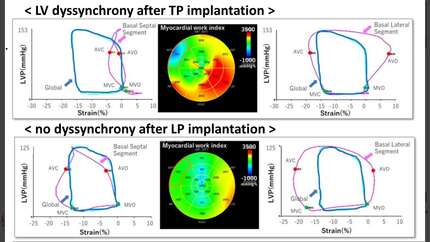
We retrospectively analyzed 48 patients (79.6±8.5 years, female 30 (62.5%)) who were newly implanted with a permanent pacemaker (19 LP and 29 TP). Patients underwent echocardiography at baseline and after implantation. Analysis included left ventricular ejection fraction (LVEF), global longitudinal strain (GLS), global work index (GWI) as myocardial work index and average septal-lateral work difference (SLWD) as an index of left ventricular dyssynchrony.
The LP patients were significantly older and had a smaller body surface area compared to the TP group (84.7±6.1 vs. 76.3±8.3 years old, p=0.0001; 1.47±0.13 vs. 1.58± 0.17 kg/m2, p = 0.01, respectively). The underlying arrhythmia necessitating pacemaker implantation included atrioventricular block (n=36), sick sinus syndrome (n=11), and bradycardic atrial fibrillation (n=1). After pacemaker implantation, there were no significant differences between the two groups in terms of QRS duration, LVEF, GLS, GWI, and SLWD (QRS duration: 150.2±12.6 vs. 143.1±23.2 msec, p = 0.26; LVEF: 53.4±9.8 vs. 50.7±8.7 %, p = 0.10; GLS: -14.2±3.9 vs. -12.7±3.5 %, p = 0.07; GWI: 1198±455 vs. 1151±460 mmHg%, p = 0.31 ; SLWD: 826±668 vs. 551±828 mmHg%, p = 0.11, LP vs. TP, respectively). The proportion of patients with post-implantation LVEF <50% and SLDW >400mmHg%, indicative of dyssynchrony, did not differ significantly between the TP and LP groups (p= 0.60; p=0.65, respectively). Additionally, when comparing parameters at baseline and after pacemaker implantation, LVEF and GLS significantly decreased in the TP group (table: Comparison of LVEF and GLS baseline and after pacemaker implantation).
LP implantation demonstrated a comparable impact on cardiac function and LV dyssynchrony relative to TP. LPs offer a safe alternative to TP, preserving cardiac function without increasing dyssynchrony. Long-term follow-up is needed to confirm sustained benefits. Comparison of EF and GLS
Contributors

Y Kanzaki
Author
H Takayama
Author
S Fujioka
Author
M Miyamura
Author
T Ito
Author
H Morita
Author
M Hoshiga
Author
You may be interested in