Pressure strain product- a novel load independent parameter for veno-arterial extracorporeal membrane oxygenation weaning
European Heart Journal


Abstract
Our group has previously described a novel speckle-tracking echocardiographic parameter, the "Pressure-Strain product" (PSP). It was investigated in a large animal model of cardiogenic shock, showing a correlation with left ventricular (LV) stroke work, and was noted to be less dependent on hemodynamic changes occurring with modification of the veno-arterial extracorporeal membrane oxygenation (V-A ECMO) flow rate. PSP was defined as the product of mean arterial pressure and magnitude of LV global longitudinal strain. V-A ECMO is indicated in drug-refractory cardiogenic shock. Detecting sufficient cardiac recovery and when to wean mechanical support is challenging with conventional echocardiographic parameters such as left ventricular ejection fraction (LVEF), due to load-dependency.
This study aimed to investigate if PSP is associated with weaning failure in cardiogenic shock patients requiring V-A ECMO support, and if this parameter is less impacted by haemodynamic changes induced by weaning from V-A ECMO.
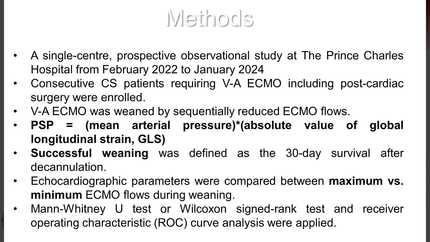
This is a single-centre, prospective observational study. Consecutive patients including post-cardiac surgery with a diagnosis of cardiogenic shock requiring V-A ECMO at The Prince Charles Hospital were recruited between February 2022 to January 2024. Echocardiographic assessments were done at sequentially reduced ECMO flows, and full and minimum support flows were evaluated. Successful weaning was defined as a 30-day survival after decannulation. Receiver operating characteristic (ROC) curve analysis was conducted to predict weaning failure. Statistical analyses were conducted using Mann-Whitney U test or Wilcoxon signed-rank test depending on being paired or not.
Out of 27 eligible patients, 21 patients were enrolled, of whom 6 patients (29%) experienced weaning failure (Table 1). A significant difference between full (2.7, IQR 2.5-3.0 L/min) and minimum (1.0, IQR 1.0-1.2 L/min) ECMO flow rates was observed (p<0.001). LV PSP at full ECMO support was lower in the weaning failure group than in the success group, yet did not reach statistical significance (368, IQR 272-839 mmHg*% vs. 1005, IQR 450-1322 mmHg*%, p=0.154). In the ROC curve analysis to detect weaning failure, PSP at full ECMO support showed the higher area under the curve (0.71, IQR 0.44-0.98, sensitivity 73%, specificity 67%) than that of LVEF (0.61, IQR 0.29-0.93, sensitivity 47%, specificity 83%) (Figure 1). There were no significant differences between PSP at full flow (796, IQR 380-1194 mmHg*%) vs. minimum flow (772, IQR 399-1208 mmHg*%, p=0.168), indicating load independence of PSP, whereas LVEF significantly altered.
In comparison to conventional indices, PSP has the potential to be less impacted by haemodynamic loading conditions and to more accurately predict weaning failure for cardiogenic shock patients supported by V-A ECMO. Larger studies are needed to confirm our results. Baseline characteristics ROC curve analysis
Contributors

M S Siriwardena
Author
H N Nonaka
Author
N O Obonyo
Author
S H Heinsar
Author
D P Platts
Author
J S Suen
Author
R N Naidoo
Author
J L Lavana
Author
J C Chan
Author
G S Scalia
Author
J F Fraser
Author
You may be interested in