Low left atrium reservoir strain predicts complex ventricular arrhythmias and burnout phase in hypertrophic cardiomyopathy
European Heart Journal


Abstract
Echocardiography plays an essential role in the diagnosis and prognosis of hypertrophic cardiomyopathy (HCM). Left atrial (LA) remodeling is common in HCM and predicts adverse events such as atrial fibrillation, stroke, heart failure, and death. However, whether it predisposes to the development of complex ventricular arrhythmias (VAs) and end-stage HCM with systolic dysfunction known as the burn-out (BO) phase is still unknown.
We investigated the different types of LA strain (reservoir, conduit, contractile) in HCM and their association with the development of VAs and BO phase.
We prospectively studied consecutive patients diagnosed with HCM via echocardiography at our medical center between 2017 and 2024. Two-dimensional speckle tracking was used to calculate the absolute (%) values of LA reservoir (Lar), conduit (LAcd), and contractile (LAct) strain. The presence of non-sustained ventricular tachycardia was assessed with a 48h ECG recording, while a 5-year risk score for SCD was calculated using the corresponding ESC online calculator. Statistical analysis was performed using the SPSS software.
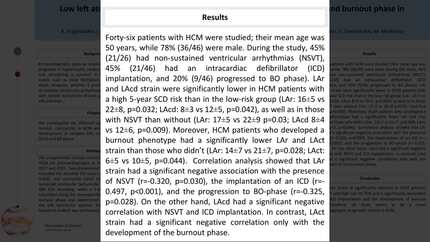
Forty-six patients with HCM were studied; their mean age was 50 years, while 78% (36/46) were male. During the study, 45% (21/26) had non-sustained ventricular arrhythmias (NSVT), 45% (21/46) had an intracardiac defibrillator (ICD) implantation, and 20% (9/46) progressed to BO phase). LAr and LAcd strain were significantly lower in HCM patients with a high 5-year SCD risk than in the low-risk group (LAr: 16±5 vs 22±8, p=0.032; LAcd: 8±3 vs 12±5, p=0.042), as well as in those with NSVT than without (LAr: 17±5 vs 22±9 p=0.03; LAcd 8±4 vs 12±6, p=0.009). Moreover, HCM patients who developed a burnout phenotype had a significantly lower LAr and LAct strain than those who didn’t (LAr: 14±7 vs 21±7, p=0.028; LAct: 6±5 vs 10±5, p=0.044). Correlation analysis showed that LAr strain had a significant negative association with the presence of NSVT (r=-0.320, p=0.030), the implantation of an ICD (r=-0.497, p<0.001), and the progression to BO-phase (r=-0.325, p=0.028). On the other hand, LAcd had a significant negative correlation with NSVT and ICD implantation. In contrast, LAct strain had a significant negative correlation only with the development of the burnout phase.
LA reservoir strain is significantly reduced in HCM patients with NSVT and high risk for SCD and is significantly associated with an ICD implantation and the development of burnout HCM. Therefore, LA strain seems to be a novel echocardiographic prognostic marker in HCM.
Contributors

You may be interested in