The predictive value of left atrial strain for incident atrial fibrillation: data from the Akershus Cardiac Examination (ACE) 1950 Study
European Heart Journal


Abstract
Atrial fibrillation (AF) is the most prevalent sustained arrhythmia worldwide, and a major risk factor for ischemic stroke and heart failure. Left atrial (LA) functional assessment by echocardiographic strain analysis is a sensitive marker of future cardiovascular events, such as incident AF after stroke, in valvular heart disease, in heart failure and in the general population.
To assess the predictive value of LASr and LASct for incident AF in a general population of 62–65-year-olds.
The Akershus Cardiac Examination (ACE) 1950 Study included 3,706 men and women from the general population of Akershus County, Norway, all born in 1950. Baseline examination was conducted between 2012 and 2015 and included echocardiographic assessment of LA strain. Incident AF was identified by new AF diagnoses from Norwegian health registries. We assessed the predictive value of LASr and LASct and adjusted for residual risk of AF by sex and the CHARGE-AF risk score. Analyses were done with LASr and LASct as continuous variables, and by quartiles of either LA strain measure ranging from quartile (Q) 1 (lowest) to Q4 (highest).
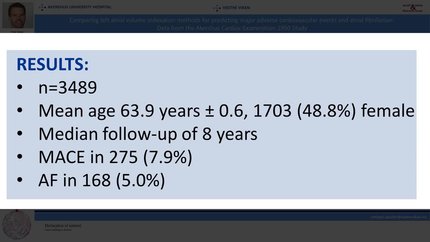
Among 3,229 participants (50.0% women) with available LA strain analysis, 95 (2.9%) had pre-existing AF and 115 (3.6%) developed new-onset AF during a median follow-up period of 6.3 (IQR 6.0-7.0) years. Demographic and clinical characteristics are presented in Table 1. Compared with participants who did not develop AF, those with incident AF had significantly lower LASr (32.5±9.0 vs 35.2±9.0%, p=0.002) and LASct (16.2±5.9% vs. 17.3±6.4%, p=0.002). Incident AF was predicted by LA strain with an adjusted hazard ratio (HR) of 1.03 (95% CI 1.01-1.06, p=0.011) per 1% decrease in LASr and an adjusted HR of 1.06 (95% CI 1.02-1.10, p=0.003) per 1% decrease in LASct. Kaplan-Meier plots of AF-free survival by quartiles of LASr and LASct show that Q1 of LASr and Q1 and Q3 of LASct were significantly associated with new-onset AF (Figure 1). Using Q4 of either strain measure as reference, the adjusted HR for AF prediction was 1.87 (95% CI 1.12-3.13, p=0.017) for Q1 of LASr and 2.55 (95% CI 1.42-4.57, p=0.002) for Q1 of LASct.
Reduced LASr and LASct predict incident AF in a general population of 62-65-year-old women and men after adjustment for CHARGE-AF and sex.
Contributors


T Berge
Author
P S Ronningen
Author
S Enger
Author
M O Pervez
Author
E B Orstad
Author

M N Lyngbakken
Author
T Omland
Author
H Rosjo
Author
You may be interested in