Prognostic value of left atrial strain for detecting atrial fibrillation in patients with acute ischemic stroke
European Heart Journal


Abstract
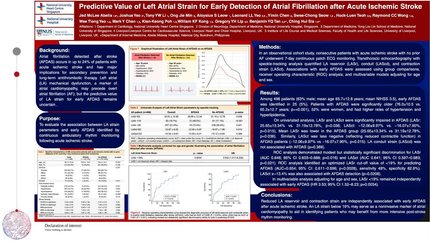
Atrial fibrillation (AF) is a major risk factor for cardioembolic stroke but often remains undetected at the time of acute ischemic stroke (AIS). Long-term monitoring, such as implantable loop recorders (ILRs), improves AF detection but is limited by invasiveness and cost, whereas Holter monitoring and serial ECGs have low diagnostic yields and lack standardization in monitoring duration and frequency. Left atrial (LA) strain, a marker of atrial dysfunction, has shown prognostic value even in patients with normal LA volume, suggesting its potential role in identifying earlier detection of LA dysfunction.
This study aimed to evaluate the prognostic value of LA strain in predicting newly diagnosed AF in AIS patients without a prior AF diagnosis.
This retrospective cohort study included 738 patients with AIS who underwent transthoracic echocardiography at a heart hospital between January 2021 and December 2023. Patients with prior AF, patent foramen ovale, anticoagulant use, inadequate LA strain measurements, or follow-up <1 year were excluded. LA strain analysis was performed using two-dimensional speckle tracking echocardiography, assessing LA reservoir strain (LASr), LA conduit strain (LASct), and LA contraction strain (LAScd). LA stiffness was calculated as E/e′ divided by LASr. The primary outcome was new-onset AF within one year, confirmed by ECG or rhythm monitoring. Univariable and multivariable Cox regression analyses were conducted to identify predictors of AF. Additionally, ROC curve analysis assessed the discriminative ability of LA strain, and Kaplan-Meier survival curves evaluated AF-free survival over one year.
Among 364 patients, 18 (5.0%) developed new-onset AF within one year. LAVI remained <40 mL/m² in both groups, with no significant difference between those with and without AF (p = 0.097). Patients who developed AF had lower LASr, LAScd, and LASct, and higher LA stiffness (20.6% vs. 28.7%, -9.7% vs. -13.2%, -11.0% vs. -16.0%, and 0.9 vs. 0.5, respectively; all p < 0.05). In Cox analysis, after adjusting for age, sex, BMI, smoking status, and BNP, LASr (HR = 0.88, 95% CI [0.81–0.95], p = 0.001), LASct (HR = 0.88, 95% CI [0.80–0.96], p = 0.005), and LA stiffness (HR = 2.99, 95% CI [1.38–6.52], p = 0.006) remained independent predictors of AF. In ROC analysis, LASr, LASct, and LA stiffness demonstrated superior predictive performance over LAVI (Figure 1). Applying the optimal cutoff values from ROC analysis, Kaplan-Meier curves showed a significantly higher incidence of AF in patients with impaired LA strain or increased LA stiffness (all p < 0.05) (Figure 2).
In AIS patients, LASr, LASct, and LA stiffness were strong independent predictors of new-onset AF. LA strain analysis may aid in risk stratification and AF detection, thereby optimizing rhythm monitoring strategies.

You may be interested in