Safety and efficacy of trans esophageal echocardiography using flexible over-tube: multicenter pilot study
European Heart Journal


Abstract
A recent review article reported that gastrointestinal complications related to transesophageal echocardiography (TEE)—including visceral perforations, mucosal damage, bleeding, and persistent odynophagia—occur in up to 28% of cases during interventional procedures.
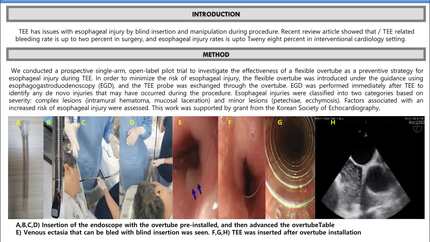
This study aimed to evaluate the efficacy of a flexible overtube in reducing esophageal injuries, assess the incidence and types of complications, and identify factors associated with oropharyngeal and esophageal lesions following TEE manipulation.
This prospective study included 30 patients undergoing TEE with a flexible overtube, a device commonly used to manage esophageal varices in patients with liver cirrhosis. Esophagogastroduodenoscopy (EGD) with a flexible overtube was performed both before and immediately after TEE to identify any new injuries that may have occurred during the procedure. Esophageal injuries were classified into two types based on severity: complex lesions (intramural hematoma, mucosal laceration) and minor lesions (petechiae, ecchymosis). The factors associated with an increased risk of esophageal injury were assessed.
30% of patients (n = 9 of 30) were on antiplatelet or anticoagulant therapy and continued their medication prior to TEE. Following TEE with an overtube, post-procedural EGD revealed that 16.7% of patients (n = 5 of 30) developed a new minor mucosal injury (petechiae or ecchymosis), whereas 82.3% (n = 25 of 30) showed no evidence of mucosal injury. No complex mucosal lesions or cases of persistent dysphagia were observed after TEE with an overtube. Patients who developed minor mucosal injuries had a higher incidence of post-procedural odynophagia (50% vs. 0%; p<0.01, Table 1). The use of antiplatelet agents was identified as an independent factor associated with an increased risk of minor mucosal injury (odds ratio: 30.63; 95% confidence interval: 1.03–822.04; p=0.04, Table 2).
TEE with a flexible overtube is a safe and effective method for minimizing mucosal injuries in the oropharynx and esophagus, particularly in patients at high risk of bleeding. When blind insertion is difficult, performing TEE through an overtube placed under EGD guidance serves as a feasible alternative.

You may be interested in