EF/MAPSE ratio: a new echocardiographic parameter for the diagnosis of cardiac amyloidosis
European Heart Journal


Abstract
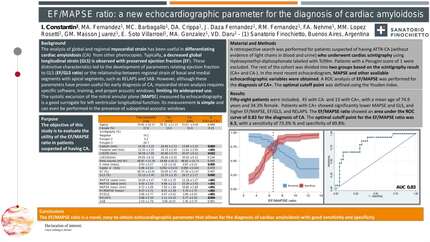
Color Doppler echocardiography is an excellent tool for cardiac amyloidosis (CA) screening. The analysis of global and regional myocardial strain has been useful in differentiating CA patients from other phenocopies. Typically, a decreased global longitudinal strain (GLS) is observed with preserved ejection fraction (EF), with greater involvement of the medial and basal segments. These distinctive characteristics led to the development of parameters relating ejection fraction to GLS (EF/GLS ratio) or the relationship between regional strain of basal and medial segments with apical segments, such as RELAPS and SAB. However, although these parameters have proven useful for early diagnosis of CA, myocardial strain analysis requires specific software, training, and proper acoustic windows, limiting its widespread use.
The systolic excursion of the mitral annular plane (MAPSE) measured by echocardiography is a good surrogate for left ventricular longitudinal function. Its measurement is simple and can even be performed in the presence of suboptimal acoustic windows.
The objective of this study is to evaluate the utility of the EF/MAPSE ratio in patients suspected of having CA.
A retrospective search was performed for patients suspected of having ATTR-CA (without evidence of light chains in blood and urine) who underwent cardiac scintigraphy using Hydroxymethyl-diphosphonate labeled with Tc99m. Patients with a Perugini score of 1 were excluded.The rest fo the cohort was divided into two groups based on the scintigraphy result (CA- and CA+). In the most recent echocardiogram, MAPSE was measured, and other available echocardiographic variables were obtained. An ROC analysis of EF/MAPSE was performed for the diagnosis of CA+. The optimal cutoff point was defined using the Youden index.Continuous variables are expressed as mean ± standard deviation. Significant differences were considered for p < 0.05. The statistical analysis was performed using JASP software and STATA13.
Fifty-eight patients were included, 45 with CA- and 13 with CA+, with a mean age of 74.9 years and 34.3% female. Table 1 describes the population characteristics and the differences between both groups. Patients with CA+ showed significantly lower MAPSE and SLG, and higher EF/MAPSE, EF/SLG, and RELAPS. The EF/MAPSE ratio showed an area under the ROC curve of 0.83 for the diagnosis of CA. The optimal cutoff point for the EF/MAPSE ratio was 6.5 , with a sensitivity of 73.3% % and specificity of 69.8% (Fig 1).
The EF/MAPSE ratio is a novel, easy-to-perform echocardiographic parameter that allows for the diagnosis of cardiac amyloidosis with good sensitivity and specificity
Contributors

M C Barbagallo
Author
D A Crippa
Author
J Daza Fernandez
Author
R M Fernandez
Author
F A Nehme
Author
M M Lopez Rosetti
Author
G M Masson Juarez
Author
E Soto Villarroel
Author
M A Gonzalez
Author
V D Daru
Author
You may be interested in