Fatty liver disease as risk factors for the clinical expression of hypertrophic cardiomyopathy
European Heart Journal


Abstract
The clinical expression of hypertrophic cardiomyopathy (HCM), both mutation-positive and -negative, remains poorly understood.
This study aimed to analyze the association between metabolic dysfunction-associated or alcohol-related steatotic liver disease (MASLD or ALD) and the clinical expression of HCM using a large cohort database.
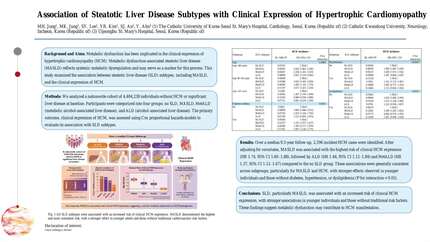
We identified 4,404,238 individuals from a nationwide cohort who were free of HCM and significant liver disease at baseline. Steatotic liver disease (SLD) was defined as a fatty liver index ≥30. Participants were categorized into four groups: no SLD, MASLD, MetALD (metabolic alcohol-associated liver disease), and ALD (alcoholic liver disease), based on the presence of metabolic dysfunction and alcohol consumption. We investigated the risk of HCM clinical expression across these categories.
During a mean follow-up of 9.2 ± 1.1 years, 2,596 cases of incident HCM were reported. Compared to the no SLD group, MASLD was associated with a 1.7-fold increased risk (adjusted HR 1.735, 95% CI 1.598-1.884), MetALD with a 1.4-fold increased risk (adjusted HR 1.368, 95% CI 1.122-1.668), and ALD with a 1.4-fold increased risk (adjusted HR 1.437, 95% CI 1.123-1.839) for the expression of clinical HCM, after adjusting for age, sex, smoking, physical activity, and comorbidity burden (Figure 1). These associations were generally consistent across different subgroups, with a stronger effect observed in younger individuals and those without a history of diabetes or hypertension (p for interaction < 0.05).
MASLD, MetALD, and ALD, particularly MASLD, were associated with an increased risk of clinical expression of HCM, with this association being more pronounced in younger individuals and those without a history of diabetes or hypertension. KM curve for the occurrence of HCM
Contributors



You may be interested in