Evaluating the LV global deformation index, a novel echocardiographic marker for prediction of heart failure in asian patients with hypertrophic cardiomyopathy
European Heart Journal


Abstract
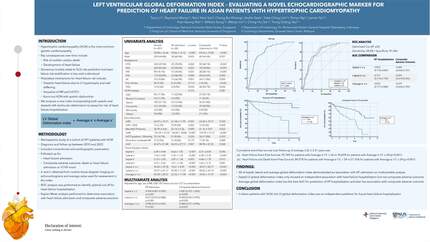
A novel tissue Doppler index, termed as the left ventricular global deformation index is proposed and assessed for its relation to the prediction of heart failure hospitalization in Asian patients with hypertrophic cardiomyopathy. This index is derived as the average e’ multiplied by the average S’ as derived on tissue doppler imaging.
This was a retrospective study involving 491 patients diagnosed with HCM between 2010 and 2022 at a tertiary cardiac center. The LV global deformation index was assessed using the average mitral annular velocity (e’) multiplied by the average systolic mitral annular velocity (s'). We believe that the LV global deformation index can capture abnormalities in both systolic and diastolic LV deformation and therefore can demonstrate prognostic value on follow-up. We tested this index against (a) eventual heart failure hospitalization as well as (b) a composite of heart failure hospitalization and death during follow-up.
The patients had a mean age of 60.1 ± 16.3 years-old and had a male preponderance (54.9%). Receiver operating characteristic (ROC) analysis identified an optimal cut-off value of 24.0 (68.0% sensitivity, 81.63% specificity). The incidence of heart failure free survival and composite adverse event free survival over a follow-up of 3.52 ± 2.51 years was 70.69% and 57.76% for patients with abnormal LV global deformation index ≤ 24 versus 95.74% and 84.57% for patients with a normal value.
Multivariable Cox regression analyses adjusting for age, sex, LV ejection fraction, LV mass index, atrial fibrillation and a history of prior heart failure showed that the average and lateral LV global deformation index retained an independent association with eventual heart failure hospitalization. The septal LV global deformation index only demonstrated an independent association with eventual heart failure hospitalization but not composite adverse outcome.
In Asian patients with HCM, the LV global deformation index was an independent predictor for future heart failure hospitalization.

You may be interested in