Linking arterial stiffness to atrial cardiomyopathy: correlation between pulse wave velocity, p-wave duration, and echocardiographic parameters
European Heart Journal


Abstract
Arterial stiffness, a predictor of cardiovascular events and mortality, can be measured noninvasively by pulse wave velocity (PWV). Evidence suggests that arterial stiffness may contribute to atrial cardiomyopathy (AtCM), which encompasses electromechanical, structural, and/or functional changes in the atria—particularly the left atrium (LA)—and has been associated with atrial fibrillation (AF), embolic stroke, and heart failure. However, a universal clinical definition of AtCM is lacking, and the relationship between PWV and AtCM remains unclear.
To evaluate whether PWV correlates with P-wave duration (PWD) and echocardiographic markers of AtCM.
A retrospective analysis was performed in patients aged ≥18 years. All patients underwent a PWV assessment (using a validated oscillometric brachial-cuff device), transthoracic echocardiography (TTE), and PWD measurement via manual digital callipers on high-resolution 12-lead ECG. Experienced cardiologists performed all evaluations/examinations. Exclusion criteria were non-sinus rhythm during evaluation, presence of a pacemaker or implantable cardioverter defibrillator, previous heart surgery, or suboptimal acoustic windows. TTE parameters included LA volume indexed by body surface area (LAViBSA), height (LAViH), and height squared (LAViH2); the latter two were used to assess LA enlargement in overweight patients better. Additionally, the interval from the onset of the P wave to the A’ peak on tissue Doppler imaging at the LA lateral wall (PA-TDI) was measured as an index of interatrial dyssynchrony, and LA reservoir strain (LARS) was also assessed. PWV was reported both as a continuous value and as categorised (normal vs. elevated) based on the device software. Because data did not follow a normal distribution, Spearman’s correlation coefficient (rs) was used, with p < 0.05 indicating significance.
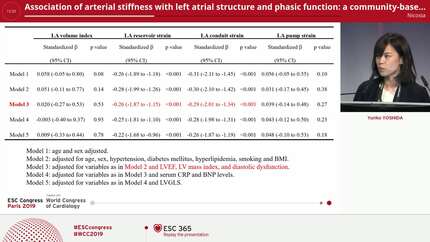
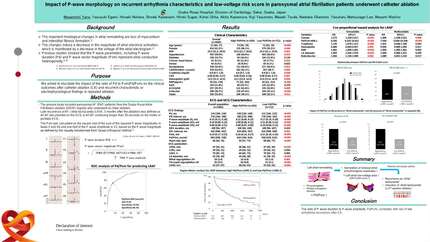
A total of 603 patients were included (mean age 62.6±15.6 years; 52.9% women). The most common comorbidities were overweight or obesity (64.8%), AF (46.8%), dyslipidemia (44.3%), and hypertension (43.3%). PWV showed significant positive correlations with LA volume, PA-TDI, and PWD, as well as a significant negative correlation with LARS (Figure 1). Among the 20.6% of patients with elevated PWV, echocardiographic and electrocardiographic markers of AtCM were significantly more pronounced (Table 1).
PWV correlates significantly with multiple indicators of AtCM, including PWD, LA volume, PA-TDI, and LARS. Arterial stiffness, assessed noninvasively by PWV, may represent a valuable marker of AtCM in clinical practice.
Contributors


I Tello Santacruz
Author
M L Fernandez Recalde
Author
S Makhoul
Author
E Piersigilli
Author
I Rios
Author
L Feole
Author
C Caceres Monie
Author
You may be interested in