The prognostic role of left atrial reservoir strain in aortic regurgitation: a step towards improved valve replacement criteria
European Heart Journal


Abstract
Aortic regurgitation (AR) is traditionally considered a slowly progressive disease leading to ventricular dilatation and dysfunction. However, older patients seem to exhibit a distinct progression characterized by diastolic dysfunction and heart failure (HF) without overt ventricular dilatation.
To assess the prognostic value of left atrial (LA) strain in patients with significant AR who do not meet guideline-based intervention criteria and to explore its potential role in refining risk stratification.
We conducted a retrospective observational study including patients with significant AR without guideline indications for intervention. Comprehensive echocardiographic evaluation included LA strain analysis. A control group matched for age, sex, and comorbidities was used for comparison. The primary endpoint was a composite of all-cause mortality and HF hospitalization over a mean follow-up of three years.
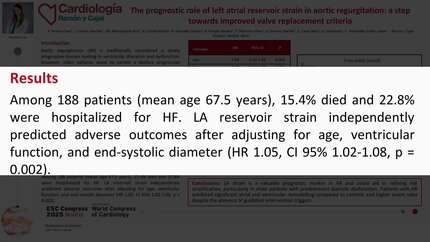
Among 188 patients (mean age 67.5 years), 15.4% died and 22.8% were hospitalized for HF. LA reservoir strain independently predicted adverse outcomes after adjusting for age, ventricular function, and end-systolic diameter (HR 1.05, CI 95% 1.02-1.08, p = 0.002). Patients with AR exhibited significant atrial and ventricular remodelling compared to controls and higher event rates despite the absence of guideline intervention triggers.
LA strain is a valuable prognostic marker in AR and could aid in refining risk stratification, particularly in older patients with predominant diastolic dysfunction. Univariate Cox Model Multivariate Cox Model
Contributors



You may be interested in