Comparative utility of echocardiographic parameters for quantifying aortic insufficiency severity in bicuspid and trileaflet aortic valves
European Heart Journal


Abstract
Quantifying the severity of aortic regurgitation (AR) using transthoracic echocardiography (TTE) remains challenging. A multi-parametric approach considering quantitative, semi-quantitative, and qualitative variables is recommended, but this increases inter-observer variability. The usefulness of these parameters has not been evaluated in patients with bicuspid aortic valve and regurgitation. In some patients, there is discordance between parameters, and it is unclear which is most useful for defining severity. The absence of a hierarchical weighting of discordant parameters could cause interobserver variability and aortic valve morphology could add more complexity. This study compared the utility of different AR severity parameters in patients with bicuspid aortic valves (BAV) versus trileaflet aortic valves (TAV).
221 consecutive patients with moderate or severe AR on comprehensive TTE were included in this study. Aortic valve morphology, left ventricular (LV) dimensions, volumes, LV ejection fraction and AR qualitative, semi-quantitative and quantitative parameters were assessed. Regurgitant mechanisms were classified according to El Khoury.
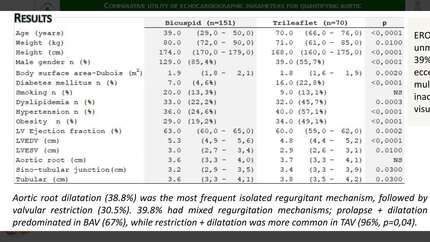
151 patients had BAV and 70 had TAV. Patients with BAV and significant AR were younger (39 vs 70 years, p < 0.001), more frequently male, and had fewer cardiovascular risk factors. Regurgitation effective orifice area (EROA) was unmeasurable in 39% due to eccentric or multiple jets or inadequate PISA visualization. The prevalence of the different parameters according to aortic valve morphology is reflected in Figure 1. There were no significant differences between bicuspid and trileaflet AR in the presence of aortic flow reversal (100% TAV vs. 97,1% BAV), vena contracta width >0.3 cm (99% vs.85,3%) or LV dilatation (91,2% vs 88,9%). However, eccentric jets were more frequent in BAV morphology (97,1% vs 33,3%, p< 0,01) and presented less frequently with half-pressure time <500ms and jet width >25%, which were more frequent in TAV morphology.
Aortic root dilatation (38.8%) was the most frequent isolated regurgitant mechanism, followed by valvular restriction (30.5%). 39.8% exhibited mixed regurgitation mechanisms; prolapse + dilatation predominated in BAV (67%), while restriction + dilatation was more common in TAV (96%, p=0,04).
While clinical differences exist between BAV and TAV AR, aortic flow reversal, VC width, and LV dilatation were significantly associated with severe AR regardless of valve phenotype. Eccentric regurgitant jets were frequent in BAV morphology and in these patients EROA was frequently unmeasurable due to jet eccentricity. The utility of individual parameters varied with valve phenotype, highlighting the need for a more standardized approach to AR quantification considering valve morphology.
Contributors


You may be interested in