AI-assisted CT assessment of tricuspid regurgitation severity correlates with echocardiographic grading
European Heart Journal


Abstract
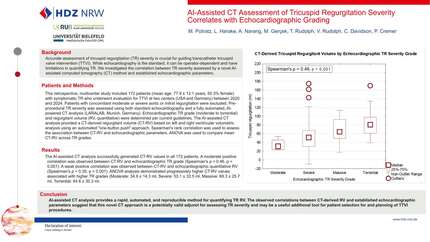
Accurate assessment of tricuspid regurgitation (TR) severity is crucial for guiding transcatheter tricuspid valve intervention (TTVI). While echocardiography is the standard, it can be operator-dependent and have limitations in quantifying TR. We investigated the correlation between TR severity assessed by a novel AI-assisted computed tomography (CT) method and established echocardiographic parameters.
This retrospective, multicenter study included 172 patients (mean age: 77.9 ± 12.1 years, 50.3% female) with symptomatic TR who underwent evaluation for TTVI at two centers (USA and Germany) between 2020 and 2024. Patients with concomitant moderate or severe aortic or mitral regurgitation were excluded. Pre-procedural TR severity was assessed using both standard echocardiography and a fully automated, AI-powered CT analysis system based on deep learning algorithms for ventricular segmentation and volume calculation. Echocardiographic TR grade (moderate to torrential) and regurgitant volume (RV, quantitative) were determined per current guidelines. The AI-assisted CT analysis provided a CT-derived regurgitant volume (CT-RV) based on left and right ventricular volumetric analysis using an automated "one-button push" approach. Spearman's rank correlation was used to assess the association between CT-RV and echocardiographic parameters. ANOVA was used to compare mean CT-RV across TR grades.
The AI-assisted CT analysis successfully generated CT-RV values in all 172 patients. A moderate positive correlation was observed between CT-RV and echocardiographic TR grade (Spearman's ρ = 0.46, p < 0.001). A weak positive correlation was observed between CT-RV and echocardiographic quantitative RV (Spearman's ρ = 0.35, p < 0.001). ANOVA analysis demonstrated progressively higher CT-RV values associated with higher TR grades (Moderate: 34.9 ± 14.3 ml, Severe: 53.1 ± 32.5 ml, Massive: 69.3 ± 25.7 ml, Torrential: 84.6 ± 30.3 ml).
AI-assisted CT analysis provides a rapid, automated, and reproducible method for quantifying TR RV. The observed correlations between CT-derived RV and established echocardiographic parameters suggest that this novel CT approach is a potentially valid adjunct for assessing TR severity and may be a useful additional tool for patient selection for and planning of TTVI procedures.

You may be interested in