Prognostic impact of the interaction between sarcopenia and aortic stenosis phenotypes on clinical outcomes
European Heart Journal


Abstract
Sarcopenia is associated with poor outcomes after transcatheter aortic valve implantation (TAVI).The phenotype of aortic stenosis (AS) is itself a prognostic determinant.How the interaction between the phenotypes of AS and sarcopenia affects the prognosis of patients who undergo TAVI remains unexplored.
To investigate how the interplay between sarcopenia and the phenotype of AS impacts on patients’ outcomes.
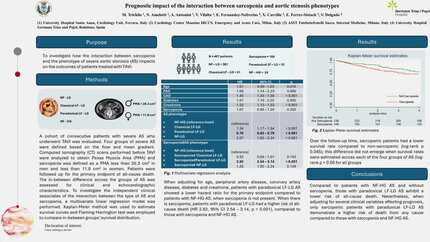
A cohort of consecutive patients with severe AS who underwent TAVI was evaluated. Four groups of severe AS were defined based on the flow and mean gradient. Computed tomography (CT) scans performed before TAVI were analyzed to obtain Psoas Muscle Area (PMA) and sarcopenia was defined as a PMA less than 20.3cm2 in men and less than 11.8cm2 in women. Patients were followed up for the primary endpoint of all-cause death. To investigate the independent clinical associates of the interaction between the type of AS and sarcopenia, a multivariate linear regression model was performed. Kaplan-Meier method was used to estimate survival curves and Flaming-Harrington test to compare in-between groups’ survival distribution.
A total of 407 patients was analyzed: 301 with normal flow-high gradient(NF-HG) AS, 51 with low flow-low gradient(LF-LG) AS, 31 with paradoxical LF-LG AS and 24 with normal flow-low gradient (NF-LG) AS. Compared to LF-LG AS, patients with NF-HG AS tended to be older, to have higher baseline levels of high-sensitive Troponin I and N-terminal brain natriuretic peptide, and a higher prevalence of sarcopenia. For patients with NF-HG AS, sarcopenia was associated with a 1.35-fold increased risk of all-cause death (95%CI,1.28-1.42;p<0.001). Compared to patients with sarcopenia and NF-HG AS, those with sarcopenia and LF-LG AS showed a 1.17-fold higher risk of the primary outcome (95%CI 1.12-1.21;p<0.001); those with sarcopenia and paradoxical LF-LG AS or NF-LG AS experience a 2.77-fold higher risk (95%CI 2.65-2.89; p<0.001) and a 1.61-fold increased risk (95%CI 1.24-2.10;p<0.001), respectively. When adjusting for age, peripheral artery disease, coronary artery disease, diabetes and creatinine, only patients with paradoxical LF-LG and sarcopenia had a higher risk of all-cause death (HR 2.82,95%CI 2.54–3.14,p<0.001), compared to those with sarcopenia and NF-HG AS(Fig.1). Over the follow-up time, sarcopenic patients had a lower survival rate compared to non-sarcopenic (log-rank p0.045); this difference did not emerge when survival rates were estimated across each of the four groups (log-rank p>0.05 for all groups;Fig.2).
Compared to patients with NF-HG AS and sarcopenia, those with sarcopenia and LF-LG AS or paradoxical LF-LG AS or NF-LG AS exhibit a higher risk of all-cause death. When adjusting for several clinical variables affecting prognosis, only sarcopenic patients with paradoxical LF-LG AS demonstrates a higher risk of death from any cause compared to those with sarcopenia and NF-HG AS.
Contributors



You may be interested in