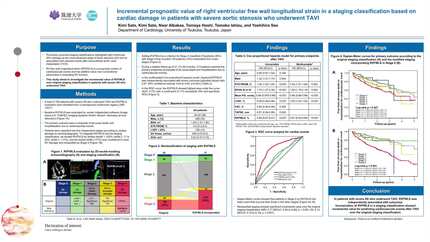
Incremental prognostic value of right ventricular free wall longitudinal strain in a staging classification based on cardiac damage in patients with severe aortic stenosis who underwent TAVI
European Heart Journal


Abstract
Previously proposed staging classifications highlighted right ventricular (RV) damage as the most advanced stage of aortic stenosis (AS) and its association with adverse events after transcatheter aortic valve implantation (TAVI). RV free wall longitudinal strain (RVFWLS) evaluated using speckle-tracking echocardiography is reportedly an independent prognostic marker of cardiovascular events in various cardiac diseases and has additive value over conventional parameters in evaluating RV function. This study aimed to investigate the incremental prognostic value of RVFWLS over stages of cardiac damage in patients with severe AS who underwent TAVI.
A total of 768 patients with available RVFWLS by speckle tracking echocardiography were selected from a retrospective multicenter registry (JSE-TAVI) including patients with severe AS who underwent TAVI. The primary outcome was a composite of all-cause death and hospitalization due to cardiovascular events. Patients were classified into five independent stages according to cardiac damage on echocardiography: Stage 0 (no damage), Stage 1 (LV damage), Stage 2 (left atrial [LA] or mitral valve damage), Stage 3 (pulmonary artery vasculature [PV] or tricuspid valve damage), or Stage 4 (RV damage). To integrate RVFWLS into the staging classification, we divided RVFWLS by tertiles (tertile 1, ≥20%; tertile 2, 17 to 20%; tertile 3, <17%), and the lowest tertile was considered to have RV damage and reclassified as Stage 4 (Figure A). During a median follow-up of 21 (12-30) months, 213 patients reached the primary endpoints. In the multivariable Cox proportional hazards model, impaired RVFWLS was independently associated with worse outcomes (adjusted hazard ratio 0.87, 95% confidence interval: 0.84 to 0.90, p<0.001). Adding RVFWLS as a criterion for Stage 4 classified 272 patients (35%) with Stage 4 that included 136 patients (18%) reclassified from lower stages (Figure B). Kaplan-Meier curves showed that patients in Stage 4 by RVFWLS had lower event-free survival than those in the other stages (p <0.001) (Figure C). Reclassified staging showed significant incremental value over the original staging classification (NRI: 0.71 [95%CI: 0.56 to 0.86], p < 0.001; IDI: 0.12 [95%CI: 0.10 to 0.15], p < 0.001).
In patients with severe AS who underwent TAVI, RVFWLS was independently associated with outcomes. Incorporation of RVFWLS in a staging classification showed incremental value for predicting cardiovascular events after TAVI over the original staging classification.

You may be interested in