Galectin-3 and myocardial dysfunction in patients with psoriatic arthritis
European Heart Journal


Abstract
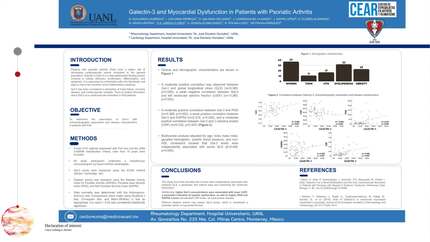
Psoriatic arthritis (PsA) is an immune-mediated condition associated with an increased risk of cardiovascular events due to disease-specific characteristics. Galectin-3 (Gal-3) is a beta-galactoside-binding protein involved in cellular adhesion, proliferation, differentiation, and apoptosis. It is expressed by endothelial cells and fibroblasts, contributing to the secretion of multiple pro-inflammatory cytokines. This protein promotes angiogenesis and fibrosis in various tissues and is considered a biomarker for heart failure, coronary disease, and cardiovascular mortality. However, there is limited information regarding Gal-3 as a cardiovascular risk biomarker in patients with PsA.
This study aimed to associate Gal-3 levels with echocardiographic parameters and disease characteristics in PsA patients.
This was a cross-sectional study including 78 patients diagnosed with PsA, according to the 2006 CASPAR classification criteria, aged >18 years. Patients with history of major cardiovascular events were excluded. All study participants underwent transthoracic echocardiography performed by two certified cardiologists blinded to clinical information. Blood samples were collected to analyze laboratory studies, including Gal-3 levels using the ELISA method. Disease activity was assessed using the Disease Activity Index for Psoriatic Arthritis (DAPSA), the Psoriasis Area Severity Index (PASI), and the Nail Psoriasis Severity Index (NAPSI). Correlations between Gal-3 levels and other variables were analyzed using Spearman’s correlation coefficient (rs).
Clinical and demographic characteristics in Table 1. A moderate positive correlation was observed between Gal-3 and global longitudinal strain (GLS) (rs=0.305, p=0.021), a low negative correlation between Gal-3 and left ventricular ejection fraction (LVEF) (rs=-0.255, p=0.024), a moderate positive correlation between Gal-3 and PASI (rs=0.331, p=0.003), a low positive correlation between Gal-3 and DAPSA (rs=0.237, p=0.037), and a moderate positive correlation between Gal-3 and C-reactive protein (CRP) (rs=0.332, p=0.003) (Figure 1). No significant correlations were found with other variables. A multivariate analysis adjusted for age, body mass index, glycated hemoglobin, systolic blood pressure, and non-HDL cholesterol showed that Gal-3 levels were independently associated with worse GLS (β=0.358, p=0.013).
Elevated Gal-3 levels were independently associated with impaired GLS, a parameter reflecting subclinical left ventricular dysfunction. Additionally, higher Gal-3 concentrations were associated with lower LVEF, indicative of left ventricular systolic dysfunction, as well as higher PASI and DAPSA scores, which measure skin and joint disease activity, respectively, and elevated CRP levels, an acute-phase reactant. Gal-3 levels may be a useful biomarker for myocardial dysfunction and disease activity in patients with PsA.
Contributors

D A Galarza-Delgado
Author
J A Cardenas-De La Garza
Author
D E Flores-Alvarado
Author
R I Arvizu-Rivera
Author
O A Garza-Flores
Author
R L Polina-Lugo
Author
A Gonzalez-Melendez
Author
C A Mascorro-Cienfuegos
Author
You may be interested in