Pulmonary vein Doppler analysis improves accuracy of 2016 ASE/EACVI algorithm for diastolic function in severe aortic stenosis: a retrospective pilot study
European Heart Journal


Abstract
Diastolic dysfunction is key in symptom progression and adverse outcomes in severe aortic stenosis (AS) (1–3). Doppler echocardiography evaluates diastolic dysfunction noninvasively, with the 2016 ASE/EACVI algorithm suggested for estimating left ventricular filling pressure (4). However, this algorithm has not been validated in severe AS, and the role of pulmonary vein (PV) Doppler in this setting remains uninvestigated.
The aim of our study was to evaluate the correlation of individual echocardiographic parameters, including the PV Doppler, with invasive mean pulmonary capillary wedge pressure (PCWP). Secondly, we tested the accuracy of the 2016 ASE/EACVI algorithm in detecting elevated PCWP.
This is a single-center retrospective observational study in 59 patients undergoing TAVR with echocardiographic exams acquired ± two days from a right heart catheterization study. All echocardiographic data were reviewed by a single expert reader.
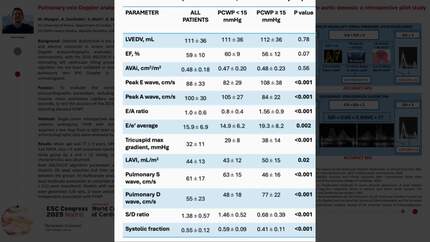
Mean age was 77 ± 9 years, 54% were males and most had NYHA class I-II with preserved ejection fraction. Dividing the study group by ≥ and < 15 mmHg, no difference in clinical characteristics was observed. Both ASE/EACVI algorithm parameters and PV systolic (S) and diastolic (D) peak velocities and their ratio (S/D) were different between the groups. At multivariate analysis, parameters with at least moderate association at univariate analysis (i.e., r coefficient > 0.5) were considered. Models with variant inflation factor < 4 were generated. E/A ratio, D wave velocity and S/D ratio showed independent association with PCWP. D velocity > 77 cm/s and S/D ratio < 0.66 showed high AUCs in detecting elevated PCWP (0.862 and 0.888) with mirrored sensitivity-specificity (63%-98% and 98%-63%, respectively). The 2016 ASE/EACVI algorithm correctly detected high PCWP in 44% of patients (AUC 0.614, sensitivity-specificity 79%-44%). Combining both a low S/D ratio with a high D wave velocity in the intermediate step of ASE/EACVI algorithm, the diagnostic accuracy reached 88% (AUC 0.810, sensitivity-specificity 64%-98%).
No single Doppler echocardiographic parameter can consistently identify elevated PCWP in severe AS patients. The 2016 ASE/EACVI algorithm showed limited accuracy to detect elevated PCWP. PV Doppler parameters have shown to be useful to enhance ASE/EACVI diastolic disfunction categorization in patients with severe AS. Abs1 Algorithms
Contributors


You may be interested in