Cardiac structure and function in patients with metabolic-associated steatotic liver disease is modified by sex
European Heart Journal


Abstract
Metabolic-Associated Steatotic Liver Disease (MASLD) has emerged as a leading cause of chronic liver disease worldwide. While cardiovascular morbidity is elevated among these patients, mechanistic understanding of cardiac structure and function remain underexplored.
We aimed to investigate cardiac structure and function among patients with MASLD and whether any sex-based differences exist.
Patients from the CoCoMASLD study were prospectively enrolled in this echocardiographic substudy. Patients underwent comprehensive echocardiography, liver assessments including the noninvasive estimate of liver scarring with Fibrosis-4 (FIB-4) Index for Liver Fibrosis, and laboratory evaluations. Demographic and medical history, including comorbidities, were collected via questionnaires and medical records, and sex-specific differences in cardiac structure, function, and biomarkers were analyzed.
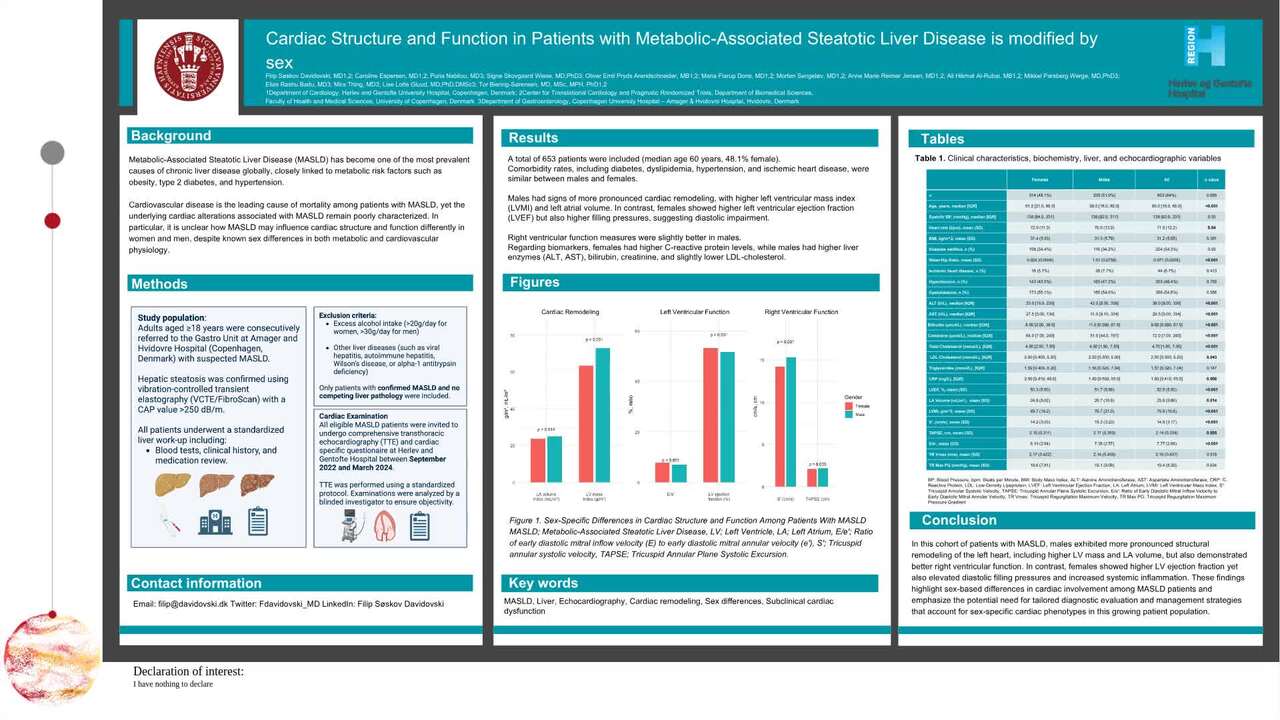
A total of 653 patients were included (median age 60.0; 48.1% female). Overall comorbidity rates were comparable between females and males, with diabetes occurring in 34.4% vs. 34.2%, hypertension in 45.5% vs. 47.2%, ischemic heart disease in 5.7% vs. 7.7%, BMI of 31.4 vs. 31.0 kg/m2, as well as a FIB-4 of 1.19 vs. 1.29 (all p>0.05). Males exhibited higher left ventricular (LV) mass index (72.9 vs. 63.4 g/m2, p<0.001) and left atrial (LA) volume index (25.1 vs. 23.7 mL/m2, p=0.014), suggesting greater cardiac remodeling. In contrast, females had higher LV ejection fraction (53.3% vs. 51.7%, p<0.001) but also elevated filling pressures (E/e’ 7.80 vs. 7.00, p<0.001). Right ventricular performance was better in men, as shown by higher TAPSE (2.17 vs. 2.10 cm, p=0.005) and tricuspid annular systolic velocity (15.3 vs. 14.2 cm/s, p<0.001). Females demonstrated significantly higher C-reactive protein (2.50 vs. 1.40 mg/L, p=0.006). At the same time, males had higher ALT (42.5 vs. 33.0 U/L, p<0.001), AST (31.0 vs. 27.5 U/L, p<0.001), bilirubin (11.0 vs. 8.0 μmol/L, p<0.001), creatinine (82.1 vs. 67.1 μmol/L, p<0.001), and a slightly lower LDL-cholesterol (2.43 vs. 2.59 mmol/L, p=0.043).
In this MASLD cohort, males showed more pronounced LV/LA remodeling but better right ventricular function, whereas females displayed preserved LV systolic function alongside higher diastolic filling pressures and inflammation. These findings underscore the importance of sex-specific diagnostic and therapeutic approaches to address distinct cardiac phenotypes in MASLD. Sex-Specific Differences
Contributors


C E Caroline Espersen
Author
P N Puria Nabilou
Author
S S W Signe Skovgaard Wiese
Author
M F D Maria Flarup Dons
Author
M S Morten Sengeloev
Author
A J Anne Marie Reimer Jensen
Author
A R Ali Hikmat Al-Rubai
Author
M W Mikkel Parsberg Werge
Author
E B Elias Rashu Badu
Author
M T Mira Thing
Author
L L G Lise Lotte Gluud
Author
T B S Tor Biering-Sorensen
Author
You may be interested in