Long-term risk of major adverse cardiovascular events in individuals with type 1 diabetes, albuminuria, and cardiac impairment
European Heart Journal


Abstract
Albuminuria is a well-established marker of kidney disease, while echocardiographic diastolic and systolic impairment can reflect cardiac dysfunction. However, the combined impact of kidney and cardiac impairment on long-term cardiovascular risk in individuals with type 1 diabetes (T1D) is unclear.
To evaluate the long-term risk of major adverse cardiovascular events (MACE) in individuals with T1D who have either albuminuria, cardiac impairment, or both, compared to those with T1D without albuminuria and cardiac impairment.
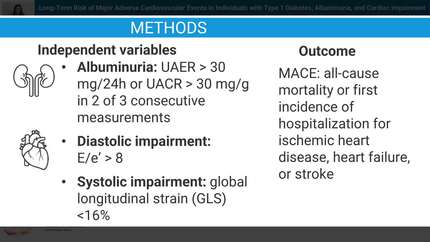
A prospective cohort of individuals with T1D without known cardiac disease were investigated with clinical examinations and echocardiography between 2010-2012. Albuminuria was defined as a 24-hour urine albumin excretion rate >30 mg or a morning albumin to creatinine ratio >30 mg/g in two out of three consecutive measurements. Diastolic impairment was defined as E/e’ ≥8 and systolic impairment as global longitudinal strain <16%. Follow-up was conducted through Danish national registries. The primary outcome was MACE, defined as a composite of incident hospital admission for ischemic heart disease, heart failure, or stroke and all-cause mortality. Unadjusted and adjusted Cox proportional hazard regression models evaluated the association between cardiac impairment and the risk of MACE according to albuminuria status. Adjustment included age, sex, diabetes duration, systolic blood pressure, statin use, HbA1c, eGFR, current smoking, and regular exercise (≥ 3.5 hours/week).
A total of 1093 participants were included. Mean (standard deviation) age at baseline was 50 (15) years, 47% were women, median (interquartile range [IQR]) diabetes duration was 26 (15-37) years, mean (SD) E/e’ was 7 (3) and mean (SD) GLS 18 (3) %. The prevalence of diastolic and systolic impairment was 33% and 17%, respectively, and 30% had albuminuria. During a median of 13.2 (IQR 12.7-14.0) years of follow-up, 266 MACE events were recorded. The risk of MACE increased incrementally from individuals without albuminuria and normal diastolic function (reference group) to individuals with either albuminuria or diastolic impairment to those with both albuminuria and diastolic impairment. After adjustment, those with both albuminuria and diastolic impairment had a 2.7-fold higher risk of MACE (HR 2.7, 95% CI 1.9-4.0, p<0.001) compared to the reference group. Similar tendencies were observed for systolic impairment (Table).
Individuals with T1D, albuminuria, and cardiac impairment had a markedly higher long-term risk of MACE compared to those without impairment or with either condition alone. These findings suggest a synergistic interaction, indicating that individuals with both conditions should receive intensive treatment to ensure strict control of all risk factors.
Contributors



You may be interested in