Differences in cardiac structure and function across NYHA classes at admission with Acute Heart Failure
European Heart Journal


Abstract
Acute heart failure (AHF) and worsening chronic heart failure (CHF) affect millions of individuals worldwide, posing significant clinical and public health challenges. NYHA classification is used to classify symptom severity in patients with heart failure (HF). Few studies have explored the association between echocardiographic measures of cardiac structure and function, lung ultrasound (LUS), bio markers, and NYHA class at admission for AFH.
We sought to investigate echocardiographic measures of cardiac structure and function in relation to NYHA classification in subjects hospitalized for AFH either de novo or exacerbations in CFH.
This was a prospective, two-center observational study enrolling adults hospitalized with signs and symptoms of AHF. Patients were examined within the first 2 days of hospitalization where echocardiography,8-zone LUS, ECG, and blood samples were collected. Patients were stratified according to their NYHA classification upon admission.
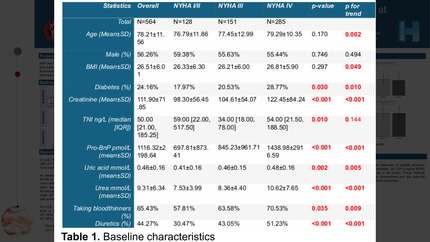
In total, 566 subjects were included (mean age ± SD, 79.4 ± 11.8) male sex 56.18%), 263 (46.3%) were admitted due exacerbation of CHF, and 299 (52.64%) due to de novo heart failure. At admission 127 patients (22.5%) were classified as NYHA I/II, 151 (26.7%) as NYHA III, and 285 (50. %) as NYHA IV. Patients in higher NYHA class were older, more likely to have diabetes, atrial fibrillation, and ischemic heart disease (table 1). On echocardiography, patients with higher NYHA class tended to have lower ejection fraction (EF), (median [IQR], 36.00 [46.00, 31.00], 38.50 [47.00, 32.00], 35.00 [46.00, 26.00], p = 0.02 for NYHA I/II, III and IV, respectively) global longitudinal strain (GLS), (10.83 [14.41, 7.87], 9.75 [13.22, 7.00], 8.84 [12.42, 6.09], p = 0.006, NYHA I/II, III and IV), lower left atrial strain during the conduit phase (LACS), (median [IQR], 7.30 [9.42, 3.62], 5.66 [7.89, 4.08], 5.33 [8.80, 2.86], p = 0.001, NYHA I/II, III and IV) and higher E/e’ ratio (median [IQR], 14.95 [19.43, 11.38], 17.20 [21.70, 11.40], 17.40 [24.40, 12,70], p = 0.006, NYHA I/II, III and IV) compared with participants with lower NYHA class. On LUS, we found that a higher NYHA class was associated with a higher number of B-lines in all zones (mean ± SD, 5±6, 8±9, 9±9, p = <0.001, NYHA I/II, III and IV). Within 180 days after discharge, 177 (31.16%) were readmitted with AFH or died. Of those, 35 (19.77%) were NYHAI/II, 49 (47.46%) were NYHA III, and 93 (52.54%) were NYHA IV.
Higher NYHA class at admission generally had worse measures of cardiac structure and function, worse biomarker profile, and more co-morbidities. On LUS a higher NYHA class was associated with a higher number of B-lines in all zones. These findings underscore the importance of early echocardiographic assessment and the potential utility of LUS in identifying patients at higher risk of adverse outcomes Bar plots over echo parameters - Baseline characteristics
Contributors

F S Davidovski
Author
A Stanchev
Author
L M Adam
Author
C Espersen
Author
E Durukan
Author
K G Skaarup
Author
E Rastoder
Author
S B Soernsen
Author
J I M H Borchsenius
Author
L S Duus
Author
K F Bernholm
Author
M F Dons
Author
T B Biering-Soerensen
Author
You may be interested in