Passive leg raise echocardiography improves non-invasive diagnosis of HFpEF: A prospective validation against invasive hemodynamics
European Heart Journal


Abstract
Heart failure with preserved ejection fraction (HFpEF) remains difficult to diagnose non-invasively. The Passive Leg Raise (PLR) test with echocardiography provides a rapid, simple non-invasive assessment of stroke volume (SV) and cardiac output (CO) reserve, potentially improving HFpEF diagnostics.
We aimed to validate echocardiographic CO/SV changes during PLR as a diagnostic tool for HFpEF compared to invasive right heart catheterization (PAWP ≥ 15 mmHg at rest or PAWP ≥ 25 mmHg during exercise).
Prospective study including 33 patients undergoing simultaneous echocardiography and right heart catheterization. Standard diastolic function parameters (E/e’ mean, TR velocity, LAVI) were recorded. Echocardiographic CO and SV changes were measured during PLR (rest to PLR). A logistic regression model was developed to predict HFpEF using diastolic function parameters alone vs. an enhanced model incorporating CO and SV changes.
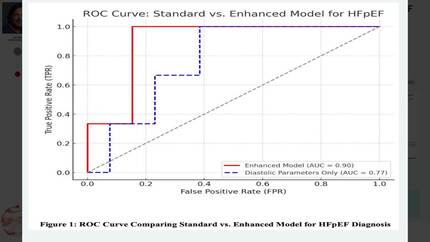
Diagnostic Performance of Standard Diastolic Function Parameters, AUC = 0.77 (moderate accuracy). Enhanced Model (Diastolic Parameters + CO and SV Changes During PLR), AUC = 0.90 (significantly improved accuracy, p < 0.05). Sensitivity = 100%, Specificity = 85% at the optimal threshold (0.285). Predictive Scoring Model Developed: HFpEF Score = (1.89 * E/e' mean) + (0.43 * TR max) + (10 * LAVI) - (7.52 * CO Change) - (8.10 * SV Change) Score > 0.285 predicts HFpEF with high sensitivity.
PLR-induced CO and SV changes significantly enhance the diagnostic accuracy of HFpEF. Adding echocardiographic CO/SV responses to standard diastolic parameters improves AUC from 0.77 to 0.90. This method could offer a non-invasive alternative to right heart catheterization for HFpEF assessment. Further validation with a larger, multi-center cohort is ongoing.
Contributors



You may be interested in