Prediabetes in ST-elevation myocardial infarction patients: implications for left ventricular function one year post-infarction
European Heart Journal


Abstract
Prediabetes is associated with worse left ventricular (LV) ejection fraction (EF) in patients with previous ST-elevation myocardial infarction (STEMI). However, the impact of prediabetes on changes in LV function in patients post-STEMI has not been evaluated.
The aim of the study was to compare changes in LVEF and LV global longitudinal strain (GLS) one year after STEMI in patients with a wide spectrum of impaired glucose metabolism.
Data were analyzed retrospectively from an ongoing large STEMI registry. Prediabetes was defined as glycated hemoglobin 5.7-6.4% in the absence of diabetes mellitus. Transthoracic echocardiography was performed within 48 hours of hospitalization and at one year follow-up. Patients were excluded if the glycemic status was unknown or changed at follow-up, or if follow-up data were unavailable. Changes in LVEF and LVGLS were compared between patients with normal glucose metabolism, prediabetes and diabetes mellitus. The effect sizes for covariables and group-time interactions were calculated using linear mixed models.
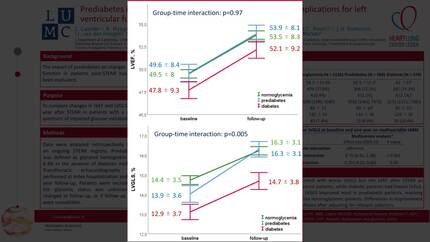
A total of 1788 patients (mean age 60±11 years; 1363 (76%) men), of whom 1126 (63%) had normal glucose metabolism, 284 (16%) had prediabetes and 378 (21%) had diabetes. During the index hospitalization normoglycemic and prediabetes patients had a similar LVEF (49.5 ± 8% vs 49.6 ± 8.4%) whereas LVEF was significantly worse in patients with diabetes (47.8 ± 9.3%; p<0.05 on Bonferroni post-hoc analysis). At one year follow-up, LVEF improved similarly across all the 3 groups (group-time interaction p 0.97, see Figure).
Baseline LVGLS differed significantly among the three groups, with the normoglycemic group having the highest LVGLS, while the diabetes group had the most reduced LVGLS (14.4 ± 3.5% in normoglycemic patients versus 13.9 ± 3.6% in prediabetic patients, versus 12.9 ± 3.7% in diabetic patients; p < 0.05 with Bonferroni post-hoc analysis). LVGLS improved in all groups, but a significant group-time effect was observed in the patients with prediabetes, who improved more as compared to the patients with normoglycemia and diabetes (group-time interaction p = 0.005; see Figure). Differences remained significant after adjusting for relevant clinical and echocardiographic factors (see Table).
Although patients with prediabetes initially present with worse LVGLS immediately following STEMI, they have the potential to recover to similar LV function as normoglycemic patients. In contrast, diabetic patients represent a higher risk group for developing persistent LV dysfunction after STEMI.
Contributors

R Myagmarjdorj
Author
X Galloo
Author
D Laenens
Author
J Stassen
Author
T Nabeta
Author
I Yedidya
Author
M C Meucci
Author
J H Kuneman
Author
I J Van Den Hoogen
Author
S E Van Rosendael
Author
H W Wu
Author
V M Van Den Brand
Author
N Ajmone Marsan
Author
J J Bax
Author
You may be interested in