Global diastology index: a novel and personalised diastolic function score derived by machine learning from 33104 echocardiograms and validated against invasive haemodynamics
European Heart Journal


Abstract
Evidence of diastolic dysfunction is a diagnostic criterion for heart failure with preserved ejection fraction (HFpEF). This is usually assessed non-invasively using echocardiography, but is complicated by confounding factors, the need to consider many parameters, and indeterminate diagnoses.
We aimed to develop a novel diastolic function scoring model that integrates echocardiographic measurements without producing indeterminate diagnoses. We also aimed to assess its performance for classifying invasively measured filling-pressures.
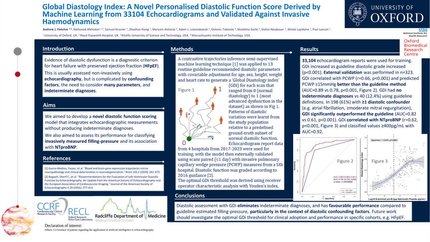
A contrastive trajectories inference semi-supervised machine learning technique [1] was applied to 13 routine guideline recommended diastolic parameters with covariable adjustment for age, sex, height, weight and heart rate to generate a ‘Global Diastology index’ (GDi) for each scan that ranged from 0 (normal diastology) to 1 (most advanced dysfunction in the dataset). The novel training approach learnt patterns of variation in diastolic parameters within the study population relative to a predefined ground truth subset of normal diastolic function. Echocardiogram report data from 4 hospitals from 2017-2023 were used for training, with the model then externally validated using scans paired (≤1 day) with invasive pulmonary capillary wedge pressure (PCWP) measures from a 5th hospital. Diastolic function was graded according to 2016 guidance [2]. The optimal GDi threshold was derived using receiver operator characteristic analysis with Youden’s index.
33,104 echocardiogram reports were used for training. GDi increased as guideline diastolic grade increased (median[interquartile range]: normal 0.15[0.13], mild 0.29[0.14], moderate 0.47[0.18], severe 0.44[0.23], p<0.001). External validation was performed on 323 pairs of invasive and echocardiographic measures. GDi correlated with PCWP (r=0.66, p<0.001) and predicted PCWP ≥15mmHg better than the guideline method (AUC=0.89 vs 0.78, p<0.001, Figure 1). GDi had no indeterminate diagnoses vs 40 (12.4%) using guideline definitions. For GDi ≥0.459 and the guideline, respectively: accuracy=80.8%/78.6%; sensitivity=74.6%/80.0%; specificity=91.5%/76.3%; positive predictive value(PV) =93.9%/85.4%; and negative PV=67.5%/68.7%. In 198 (61%) of the pairs with ≥1 diastolic confounder (e.g. atrial fibrillation, ≥moderate mitral regurgitation), GDi significantly outperformed the guideline (AUC=0.82 vs 0.61, p<0.001). GDi correlated with NTproBNP (r=0.62, p<0.001, Figure 2) and classified values ≥400pg/mL with AUC=0.92.
Diastolic assessment with GDi eliminates indeterminate diagnoses, and has favourable performance compared to guideline estimated filling-pressure, particularly in the context of diastolic confounding factors. Future work should investigate the optimal GDi threshold for clinical adoption and performance in specific cohorts, e.g. HFpEF.
Contributors

A Fletcher
Author
Royal Papworth Hospital NHS Foundation Trust Cambridge , United Kingdom of Great Britain & Northern Ireland
M Alkhodari
Author
S Krasner
Author
Z Xiong
Author
M Alsharqi
Author
A J Lewandowski
Author
D Taboada-Buasso
Author
M Garbi
Author
S Neubauer
Author
W Lapidaire
Author
P Leeson
Author
You may be interested in