Proteomic signatures associated with diastolic dysfunction and cardiac remodelling in a general population: insights from the Bialystok PLUS study
European Heart Journal


Abstract
The progression of prediabetes and diabetes leads to cardiac remodelling, with diastolic dysfunction of the left ventricle being one of the earliest detectable changes in echocardiography. This mechanism is still not fully clarified. Advances in proteomic analysis offer new insights into the molecular mechanisms underlying these cardiac abnormalities. This study aimed to investigate whether the proteomic profile is associated with echocardiographic filling parameters in a general population without major cardiovascular diseases.
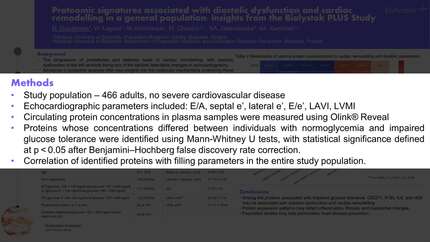
The study was conducted on 466 individuals (mean age 52 ± 10.5 years, 48.1% men) from the general population-based Białystok PLUS study. Transthoracic echocardiography, including pulsed-wave and tissue Doppler imaging, was performed using the Vivid E9 system (GE Healthcare). The left ventricular mass index (LVMI) and left atrial volume index (LAVI) were calculated by indexing to body surface area. The levels of circulating proteins in plasma samples were measured using Olink® Reveal, an innovative high-throughput platform developed by Olink Proteomics that utilizes the Proximity Extension Assay (PEA) technology. First, proteins were identified that differentiate between those with normal glucose tolerance and those with impaired glucose tolerance in the study population. For this, the Benjamini-Hochberg false discovery correction (FDR) method was used for multiple comparisons. These proteins were then correlated (Pearson's correlation) with the echocardiographic filling parameters in the whole of the study population. The mean echocardiographic values were as follows: septal e' velocity 9.59 ± 2.26 cm/s, lateral e' velocity 11.73 ± 3.18 cm/s, E/a ratio 1.27 ± 0.46, E/e' ratio 7.12 ± 1.9, LAVI 22.29 ± 7.14 mL/m², LVMI 77.17 ± 18.46 g/m².Correlations of individual proteins with echocardiographic parameters are shown in Table 1.
Among the proteins linked to impaired glucose tolerance, CDCP1, IFI30, IL-6 and HAVCR1 may be involved in diastolic dysfunction and cardiac remodelling. Their expression patterns may reflect increased inflammatory processes, fibrosis and structural and functional changes in the myocardium. Relationship of plasma protein c
Contributors

You may be interested in