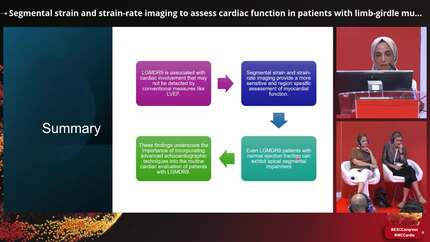
Segmental strain and strain-rate imaging to assess cardiac function in patients with limb-girdle muscular dystrophy R9; the Norwegian LGMDR9 cohort study
European Heart Journal


Abstract
Cardiomyopathy is a prevalent feature of limb-girdle muscular dystrophy R9 (LGMDR9) and early detection of cardiac involvement may improve prognosis. Utility of strain and strain-rate imaging has not been studied in patients with LGMDR9. Here, we aimed to assess cardiac function in patients with LGMDR9 using global and segmental myocardial function imaging.
A total of 42 participants (age at 23 – 71 years) of The Norwegian LGMDR9 cohort study were enrolled consecutively, and compared to a control group (N = 97, age at 40 – 69 years) from the population-based Tromsø Study. Conventional and speckle tracking echocardiography were performed to assess cardiac function. Echocardiographic parameters were analyzed using univariate analysis and linear regression adjusted for age and sex.
Patients with LGMDR9 more often present reduced left ventricular ejection fraction (LVEF) (1 [1.1%] of controls vs. 11 [26.2%] of patients, p < 0.001) and decreased absolute levels of myocardial global longitudinal strain at end-systole (GLS) (6 [6.3%] of controls vs. 17 [40.5%] of patients, p < 0.001). Patients with LGMDR9 had increased left ventricular volume and internal diameter at end systole. Diastolic dysfunction in patients was evident with reduced early to late ventricular filling velocities and further verified with decreased peak longitudinal strain-rate during early diastole and increased peak longitudinal strain-rate during atrial contraction. Importantly, segmentation revealed region-specific differences in strain and strain-rate; apical and medial segments had decreased absolute segmental strain while strain remained largely unaffected in the basal segments (Figure 1). Notably, patients with normal LVEF likewise displayed more often reduced GLS (6 [7.0%] of controls vs. 8 [25.8%] of patients; p = 0.006) and displayed region-specific alterations in strain and strain-rate.
We demonstrated that patients with LGMDR9 exhibit impaired systolic and diastolic function with the apical and medial segments of the left ventricle predominantly affected. Strain and strain-rate parameters might be used as sensitive markers of myocardial function in clinical management of patients with LGMDR9 and interventional studies. Mean estimates of segmental strain.
Contributors

You may be interested in