Evaluation of a fully automated AI-model for measuruement and diagnosis of LV-diastolic dysfunction in echocardiography
European Heart Journal


Abstract
Accurate diagnosis of left ventricular (LV) diastolic dysfunction (DD) with 2D transthoracic echocardiography (Echo) provides prognostic information, and helps guide treatment decisions.
We sought to validate a fully automated artificial intelligence (AI) system for LV-DD diagnosis in Echo against clinician assessment as the reference method.
A total of 526 consecutive patients with normal LV ejection fraction and no severe valvular heart disease underwent routine Echo at our tertiary hospital. Clinicians with over 5 years of experience manually measured Doppler peak trans-mitral early velocity (E), tissue Doppler lateral annular mitral valve early diastolic velocity (E’), peak tricuspid regurgitation velocity (TRV), and biplane left atrial volume index (LAVi) (Figure 1). The AI system performed fully automated view selection and measurement on the Echo exams. Pearson’s correlation coefficient (R) and mean absolute error (MAE) were used to assess agreement between AI and clinician measurements. AI performance in diagnosing LV-DD was evaluated using synthesized criteria (E/E’ ratio > 14, and either TRV > 2.8 m/s or LAVi > 34 ml/m²).
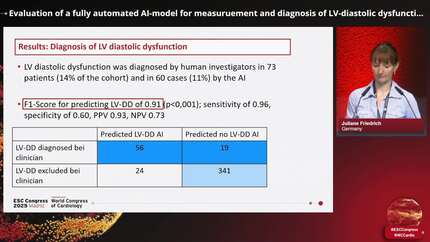
Strong correlations were observed between AI and clinician measurements values for E, E’, and E/E’-ratio (R = 0.78, MAE = 9.6; R = 0.69, MAE = 1.6; R = 0.78, MAE = 2.0, respectively) (Figure 1, central panel). Excellent correlations were found for LAVi an TRV (R = 0.87, MAE = 6.2;R = 0.79, MAE = 0.45). Clinicians diagnosed LV-DD in 73 (14%) patients, while AI identified 60 (11%) cases. The AI showed an excellent F1-score of 0.91 (p<0.001) for detecting LV-DD, with sensitivity 0.96, specificity 0.60, positive predictive value 0.93, and negative predictive value 0.73.
These findings demonstrate the potential of an AI-based application for fully automated view selection and measurement of LV diastolic function parameters, showing strong agreement with human assessment in Echo.
Contributors

You may be interested in