Multicenter study on the diagnostic accuracy of left ventricular hypertrophy using a fully automated echocardiographic analysis system with artificial intelligence
European Heart Journal


Abstract
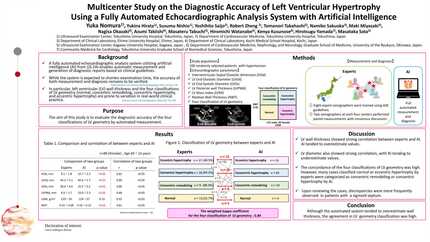
A fully automated echocardiographic analysis system utilizing artificial intelligence was provided. It enables to generate diagnostic reports based on guidelines through zero-click measurements. While the system is expected to shorten examination time, the accuracy of both measurements and diagnoses remains to be verified. In particular, left ventricular wall thickness and the four classifications of left ventricular hypertrophy (normal, concentric remodeling, concentric hypertrophy, and eccentric hypertrophy) are prone to variation in real-world clinical practice. In this study, we aimed to investigate the diagnostic accuracy of the four classifications of left ventricular hypertrophy by automated measurement using this system.
A total of 100 patients with hypertension, observed during echocardiographic examination, were included to the study. The average measurements by a total of eight experts from four centers were used as the gold standard, and the same left ventricular long-axis cross-sectional moving images were compared for agreement between the fully automated measurements and the four classifications of left ventricular hypertrophy. For expert measurements of left ventricular wall thickness, after learning in a preliminary meeting using guidelines published by the Association for Echocardiography (ASE) and the European Association of Cardiovascular Imaging (EACVI), experts at each institution paired up and performed measurements engaging in discussion. For statistical analysis, we used the Student's t-test to compare continuous variables and the weighted kappa coefficients to assess diagnostic agreement.
The fully automated echocardiographic analysis system was able to measure 89 of 100 cases. Automatic measurements of ventricular septal wall thickness and left ventricular posterior wall thickness were significantly higher than the average of four-center (10.7±2.2mm vs. 9.1±1.8mm, p< 0.05, and 10.1±2.3 mm vs. 8.9±1.7mm, p< 0.05, respectively). The weighted kappa coefficient for the four categories of left ventricular hypertrophy was 0.84. Analysis of the agreement rate by classification revealed that concentric hypertrophy showed the highest agreement rate (89.3%), followed by concentric remodeling (88.9%). In contrast, eccentric hypertrophy (40.5%) and normal (26.7%) showed lower concordance rates (Figure).
Although the fully automated echocardiographic analysis system tended to overestimate wall thickness, the agreement rate for left ventricular hypertrophy classification was high.
Contributors


R Zheng
Author

N Okazaki
Author
A Takiishi
Author
N Sakuoka
Author
M Miyazaki
Author
M Tabuchi
Author
H Watanabe
Author

H Yamada
Author
You may be interested in