Assessing the contribution of cycle selection to inter-observer variability in echocardiographic measurements
European Heart Journal


Abstract
Echocardiographic measurements are a cornerstone in clinical routine, requiring the precise identification of end-diastolic (ED) and end-systolic (ES) phases as a prerequisite for their calculation [1]. While previous studies have examined variability in echocardiography, the specific contribution of cycle selection to measurement variability remains unclear [2]. Understanding this impact is essential for improving reliability, reducing inter-observer differences, and guiding standardization efforts in clinical practice.
This study examines the impact of cycle selection on inter-observer variability in echocardiographic clinical metrics.
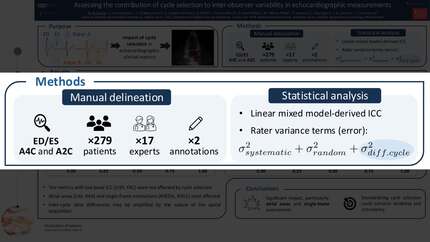
Ventricles and atria were manually delineated at ED and ES by 2 independent sonographers from a pool of 17 experts (5.8 ± 3.2 years of experience) on apical 2-chamber and 4-chamber sequences from a cohort of 279 patients (median age (IQR): 65 (55-74) years; 40% female). These delineations were used to compute chamber areas and derive 10 standard clinical metrics, routinely used to assess cardiac morphology and function.
Variability in clinical metrics was quantified using a linear mixed-effects model. The model included random effect variance terms for population variability and for rater variability, decomposed into: rater systematic error variance, rater random error variance, and rater variance related to cycle selection. This model was used to compute the intraclass correlation coefficient (ICC) (as defined in [3]) and the relative contribution of cycle variance to total rater variance, which is independent to population variance.
Overall, the impact of cycle selection on metric variance was significant (Figure 1), but highly heterogenous ranging from negligible (e.g., LVEF) to accounting for the majority of the rater variability (e.g., LAV). The clinical metrics most affected were those based on atrial areas (LAV, RAA) or single-frame estimations (RVEDA, RVD1), which make them intrinsically more sensitive to phase deviations. The ICC for these metrics was the highest among all metrics when the same cycle was selected by both raters and was significantly reduced in case of cycle discrepancy (Figure 2). We hypothesise that inter-cycle atria differences could be amplified by the nature of the apical acquisition, where the acquisition plane is centred on the ventricle and the atria are the farthest to the probe. This could explain why LAV exhibited the greatest sensitivity to cycle selection. The metrics with low basal ICC (LVEF, FAC), where the total rater variability was similar to population variability, were not affected by cycle selection.
Cycle selection significantly impacts the variability of echocardiographic measurements, particularly for metrics based on atrial areas and single-frame assessments. Standardizing cycle selection could enhance reliability and consistency, ultimately improving inter-observer agreement and clinical decision-making.
Contributors

M N Bossa
Author
L Garcia-Elcano
Author
J Giraldez Suarez
Author
E Giraldo Del Viejo
Author
A Berto
Author
I Garcia-Sineriz
Author
D Garcia-Mato
Author
M Galvan Prieto
Author
P Lamata
Author
C Diez-Lopez
Author
J A Cabrera
Author
You may be interested in