Validation of a multi-video view-informed vision-language model for echocardiographic assessment in Japanese patients
European Heart Journal


Abstract
Artificial intelligence (AI) has the potential to enhance echocardiographic interpretation; however, overfitting remains a major limitation, potentially reducing generalizability across diverse populations. EchoCLIP is a vision-language AI model designed to integrate multi-view echocardiographic video data, with Asians comprising only 7.5% of the training dataset. To address this, we validated EchoCLIP in Japanese patients undergoing both echocardiography and right heart catheterization (RHC) for chronic heart failure (CHF) assessment.
This study aimed to validate the accuracy of EchoCLIP in CHF patients undergoing echocardiographic and invasive hemodynamic assessments.
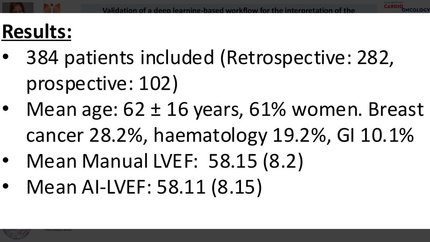
This retrospective validation study included 361 patients with stable CHF who underwent echocardiography and RHC between 2012 and 2019.AI-derived echocardiographic measurements were compared with expert assessments and invasive hemodynamic parameters. Tricuspid regurgitation (TR) velocity measurements with inadequate imaging quality were excluded, resulting in a final analysis cohort of 270 cases.
To assess hemodynamics, AI-derived and expert-assessed pulmonary artery systolic pressure (PASP) values were compared with catheterization-measured systolic pulmonary artery pressure (SPAP). Additionally, mean pulmonary artery pressure (MPAP) was estimated using Chemla's equation (2004): MPAP = 0.61 × SPAP + 2. Echocardiographic and AI-derived MPAP estimates were then compared with catheterization-derived MPAP to further evaluate the accuracy of AI-based hemodynamic estimation.
Among the 361 cases, the median interval between echocardiography and RHC was 6 days. AI-derived left ventricular ejection fraction (LVEF) strongly correlated with expert-assessed LVEF (r = 0.860, p < 0.0001). In 270 cases with adequate TR velocity imaging, the correlation between AI-derived PASP and expert-assessed PASP was r = 0.39 (p < 0.0001). Bland-Altman analysis demonstrated minimal bias for LVEF (-0.06%, 95% limits: -14.8% to 14.7%) and moderate bias for PASP (2.33 mmHg, 95% limits: -21.73 to 26.39 mmHg) (Table A).
AI-derived PASP demonstrated a stronger correlation with catheterization-measured SPAP (r = 0.47, p < 0.0001) compared to echocardiographic PASP (r = 0.38, p < 0.001), with no significant difference between the correlations (Steiger's Z = 0.98, p = 0.33). Similarly, AI-derived MPAP showed a higher correlation with catheterization-derived MPAP (r = 0.51, p < 0.0001) than with echocardiographic MPAP (r = 0.37, p < 0.0001), with no significant difference between the correlations (Steiger's Z = 1.52, p = 0.13) (Table B).
EchoCLIP demonstrated similar performance to those with humans in the echocardiographic analysis of Japanese CHF patients. AI-derived pulmonary pressure estimates correlated numerically better but without statistical significance against invasive measurements, when compared to manual estimates by human.
Contributors


X Zhou
Author
J Kirigara
Author
Y Katayama
Author
K Ozawa
Author
Y Hiroi
Author
X Zhu
Author
K Negishi
Author
You may be interested in