Artificial intelligence-enabled electrocardiography and echocardiography to track preclinical progression of transthyretin amyloid cardiomyopathy
European Heart Journal


Abstract
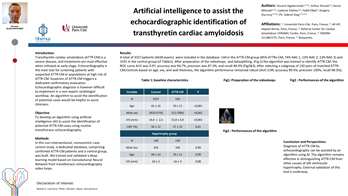
The diagnosis of transthyretin amyloid cardiomyopathy (ATTR-CM) requires advanced imaging, precluding large-scale preclinical testing. Artificial intelligence (AI)-enabled transthoracic echocardiography (TTE) and electrocardiography (ECG) may provide a scalable strategy for preclinical monitoring.
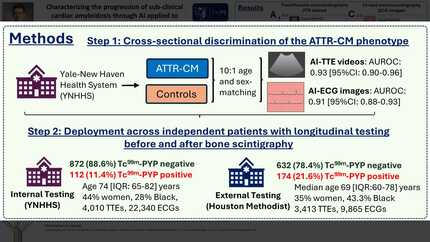
This was a retrospective analysis of individuals referred for nuclear cardiac amyloid testing at the Yale-New Haven Health System (YNHHS, internal cohort) and Houston Methodist Hospitals (HMH, external cohort). Deep learning models trained to discriminate ATTR-CM from age/sex-matched controls on TTE videos (AI-Echo) and ECG images (AI-ECG) were deployed to generate study-level ATTR-CM probabilities (0%–100%). Longitudinal trends in AI-derived probabilities were examined using age/sex-adjusted linear mixed models, and their discrimination of future disease was evaluated across preclinical stages.
Among 984 participants at YNHHS (median age 74 years, 44.3% female) and 806 at HMH (median age 69 years, 34.5% female), 112 (11.4%) and 174 (21.6%) tested positive for ATTR-CM, respectively. Across cohorts and modalities, AI-derived ATTR-CM probabilities from 7352 TTEs and 32 205 ECGs diverged as early as 3 years before diagnosis in cases vs controls (
Artificial intelligence–enabled echocardiography and electrocardiography may enable scalable risk stratification of ATTR-CM during its preclinical course.
Contributors


Veer Sangha
Author
Sumukh Vasisht Shankar
Author
Andreas Coppi
Author
Harlan M Krumholz
Author
Khurram Nasir
Author
Edward J Miller
Author
Cesia Gallegos Kattan
Author
Mouaz H Al-Mallah
Author
Sadeer Al-Kindi
Author

You may be interested in