The role of uremic toxin indoxyl sulfate in the pathophysiology of aortic valve stenosis
Cardiovascular Research


Abstract
Chronic kidney disease (CKD) is closely associated with cardiovascular disease (CVD). This includes aortic valve stenosis (AS), one of the most common valve diseases among adults. CKD leads to the retention of uremic toxins such as indoxyl sulfate (IS), which is known to induce inflammatory and pro-calcific processes. We hypothesize that IS specifically induces AS formation.
Stimulation of human valvular interstitial cells (VICs) with IS in addition to phosphate led to increased calcification. RNA sequencing identified naked cuticle homologue 2 (NKD2) as an up-regulated gene in VICs under uremic conditions. Knockdown of NKD2 reduced calcification of VICs and upregulation of IL-6. The organic anion transporting polypeptide 3A1 (OAT3A1) was identified to mediate IS uptake as well as upregulation of NKD2 and IL-6. We identified NF-κB signalling to be involved in IS-induced IL-6 upregulation.
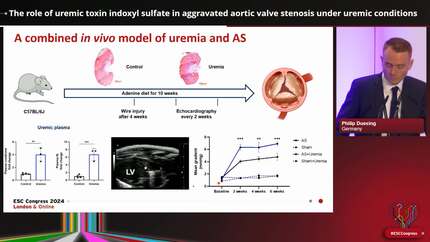
Uremic conditions aggravate AS development in mice by inducing valvular fibrosis and macrophage infiltration. IS is involved in this process and stimulates monocyte differentiation and adhesion to the valvular endothelium. On a cellular level, we hypothesize that IS-mediated NKD2 induction leads to a calcifying and inflammatory response in VICs.
Contributors

Philip Düsing
Author
Isabel Göbel
Author
Ansgar Ackerschott
Author
Laurine Reese
Author
Patrick Giavalisco
Author
Frederik Dethloff
Author
Sven Thomas Niepmann
Author
Marta Stei
Author
Thomas Beiert
Author
Sebastian Zimmer
Author
Christian Kurts
Author
Georg Nickenig
Author
Felix Jansen
Author

You may be interested in