Gender specific aspects of digital screening for atrial fibrillation: insights from the randomized eBRAVE-AF trial
European Heart Journal - Digital Health


Abstract
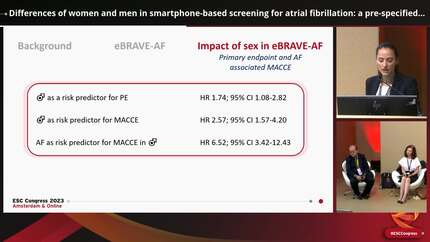
Smartphone-based digital screening was shown to increase the detection rate of atrial fibrillation (AF) requiring oral anticoagulation (OAC) compared with usual care. In this pre-specified subgroup analysis of the eBRAVE-AF trial, we explored sex-specific differences in digital AF-screening.
In eBRAVE-AF (NCT04250220), participating policyholders of a German health insurance company were randomly assigned to a 6-month digital or conventional AF-screening strategy. For digital screening, participants used smartphone-based photoplethysmography (PPG) to detect pulse wave irregularities, which were confirmed using 14-day external ECG-recorders. The primary endpoint was newly diagnosed AF treated with OAC. After 6 months, participants were assigned to a second, cross-over study-phase. The efficacy of AF-screening in women and men was assessed by Cox-regression analysis. 5551 (31% females; 55% ≥ 65 years) of 67 488 invited policyholders free of AF participated in the study and were randomly assigned to digital screening (
Men showed higher willingness to participate in this digital study and digital AF-screening was effective for them. While digital screening increased the detection rate of AF with OAC in women, the effect was not statistically significant, likely due to limited power.
Contributors

Luisa Freyer
Author
Peter Spielbichler
Author
Lukas von Stülpnagel
Author
Konstantinos Mourouzis
Author
Lukas Tenbrink
Author
Laura Elisa Villegas Sierra
Author
Maria F Vogl
Author
Lauren E Sams
Author
Annika Schneidewind
Author
Mathias Klemm
Author

Axel Bauer
Author

You may be interested in