Restrictive cardiomyopathy due to new mutation in the ACTN2 gene: a case report
European Heart Journal - Case Reports


Abstract
Restrictive cardiomyopathy (RCM) is a relatively rare cardiomyopathy. We report a case of familial restrictive cardiomyopathy confirmed by myocardial biopsy and genetic testing.
A 19-year-old male presented with recurrent syncope and cardiac arrest episodes over 1 year. Genetic testing identified a novel heterozygous insertion mutation (c.2489_2490insTTGCT, p.Q830Hfs*73) in the ACTN2 gene, altering a highly conserved amino acid sequence. Immunohistochemical analysis of endomyocardial biopsies revealed significantly elevated ACTN2 protein expression (77.34% positivity, H-Score 132.14). This mutation represents a likely pathogenic variant accounting for sudden cardiac deaths in multiple male family members.
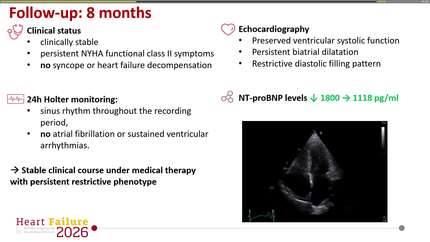
Restrictive cardiomyopathy has a rigid, noncompliant left ventricle, and left ventricular systolic function is usually preserved in the early stages of RCM but tends to deteriorate over time. In this case, the only adaptive response that can increase cardiac output is an increase in the heart rate, which may be attenuated in patients with concomitant autonomic dysfunction, thereby increasing the risk of hypotension during exercise. Therefore, hypotension due to decreased left cardiac output may have been the main cause of post-exercise syncope in this case.
In this report, we used whole-exome sequencing to identify a mutation in the ACTN2 gene of this RCM patient. Subsequently, we performed a one-generation validation in his mother and his brother and analysed the correlation between this gene variant and the RCM phenotype. This may be helpful for early identification and diagnosis of RCM.
Contributors

Zhiyu Liu
Author
Jing Bai
Author
Junnan Tang
Author
Tina Khan
Author
Takeshi Kitai
Author
Bo Lan
Author
Arif Albulushi
Author
Jack Haslett
Author
Emanuele Monda
Author
Deepti Ranganathan
Author
You may be interested in