Implementation of lead V8 as a simple non-invasive tool to improve patient selection in CRT and guide LV lead placement
EP Europace Journal


Abstract
CRT improves outcomes in heart failure patients with electrical dyssynchrony. The QLV interval, a marker of delayed left ventricular (LV) activation, independently predicts CRT response. This study aimed to determine whether activation time measured in surface ECG lead V8 reflects postero-lateral LV delay by correlating with the QLV interval during biventricular (BiV) CRT implantation.
Consecutive patients with wide QRS (non-RBBB) undergoing BiV-CRT or generator change were prospectively enrolled. Surface ECGs were recorded with the V5 electrode repositioned to the V8 location. Local wavefront activation was determined using the steepest negative downslope of the precordial leads, referred to as the negative derivative activation time (NDAT). The LV lead was connected to the EP recording system, and NDAT and QLV measurements were obtained.
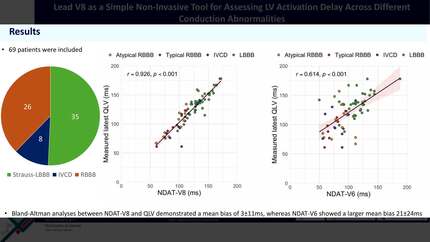
Forty-three patients were included. The NDAT in V8 strongly correlated with the QLV interval (r = 0.895; mean difference 1 ± 11 ms) across both LBBB and IVCD patterns. In contrast, NDAT in V6 showed weaker correlation (r = 0.592; mean difference 21 ± 24 ms). During LV-only pacing, a QS morphology in V8 consistently indicated postero-lateral lead placement. More anterior/apical lead positions showed larger QLV–NDAT V8 differences and non-QS morphologies, indicating suboptimal positioning.
NDAT in lead V8 is a non-invasive marker of delayed activation in the postero-lateral LV, outperforming V6 in identifying late activation. When combined with LV-paced QRS morphology, V8 facilitates accurate lead localization without additional tools. These findings may support the use of lead V8 to refine patient selection and optimize CRT delivery.
Contributors


Johan van Koll
Author
Peter Tai
Author
Vidal Essebag
Author
Tomy A Hadjis
Author
Theo A R Lankveld
Author
Antonius M W van Stipdonk
Author
Uyên C Nguyên
Author
Justin Luermans
Author
Atul Verma
Author
Kevin Vernooy
Author
You may be interested in