Urgent surgery vs fibrinolytic therapy for left-sided prosthetic valve thrombosis: a randomized trial
European Heart Journal


Abstract
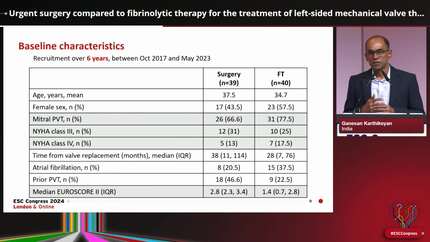
Left-sided mechanical prosthetic valve thrombosis (PVT) is common in low-resource settings. Treatment is either by fibrinolytic therapy (FT) or urgent surgery. This is the first randomized controlled trial (RCT) comparing urgent surgery with FT for symptomatic left-sided PVT.
This is a single-centre RCT comparing urgent surgery with FT (low-dose, slow-infusion tissue plasminogen activator [t-PA]) in patients with symptomatic left-sided PVT. The primary outcome was complete clinical response, defined as discharge from hospital with completely restored valve function, without major complications. The primary safety outcome was a composite of death, non-fatal stroke, non-fatal major bleed, or systemic embolism, at discharge. Outcomes were assessed by investigators blinded to treatment allocation.
Over a 6-year period, 79 patients were randomized to urgent surgery (
In symptomatic left-sided PVT, urgent surgery is not more efficacious than FT. Surgery is associated with a higher risk of complications, including death, while FT is more often associated with residual valve dysfunction.
Contributors

Ganesan Karthikeyan
Author
All India Institute of Medical Sciences AIIMS New Delhi New Delhi , India

Palleti Rajashekar
Author
Niveditha Devasenapathy
Author
Shyamashree Biswas
Author
Bharathraj Kidambi
Author
Aayush Singal
Author
Mohsin Raj Mantoo
Author
Manoj Soni
Author
Gaurav Purohit
Author
Milind P Hote
Author
Sandeep Singh
Author
Devagourou Velayoudam
Author
You may be interested in