Atrial fibrillation burden and symptom, quality of life, and healthcare resource utilization after cryoballoon ablation in persistent atrial fibrillation
EP Europace Journal


Abstract
To investigate the relationship between continuously monitored atrial fibrillation (AF) burden after cryoballoon ablation (CBA) and improvements in AF-related symptoms, quality of life (QoL), and AF-related healthcare resource utilization (HCRU) in early persistent AF.
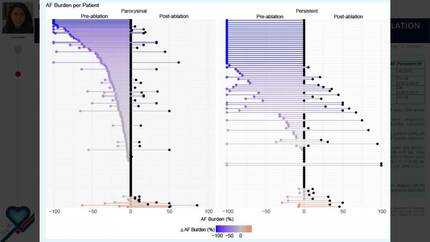
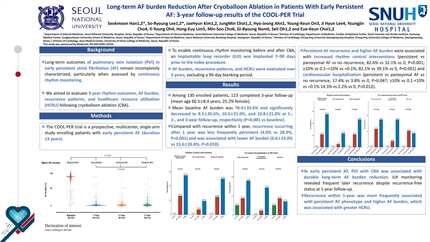
This secondary analysis of the multicentre COOL-PER trial included patients with early persistent AF who underwent CBA and continuous monitoring via an implantable loop recorder. Post-CBA AF burden was defined as the percentage of time in AF between 9- and 12-month after CBA, categorized as <0.1%, 0.1 to <10%, and ≥10%. Symptom improvement was assessed using the European Heart Rhythm Association symptom score and QoL with the SF-36 survey. AF-related HCRU was defined as rhythm control interventions after the 90-day blanking period and cardiovascular-related hospitalizations or emergency room visits. Among 130 patients (mean baseline AF burden 77 ± 34%), AF burden significantly decreased post-CBA, with 50.0% achieving <0.1%, 28.5% in 0.1 to <10%, and 21.5% ≥ 10%. Symptom improvement rate was highest in the <0.1% group (89.2%), followed by the 0.1 to <10% (78.4%) and ≥10% (46.4%) groups (
In early persistent AF, lower AF burden 1-year post-CBA was associated with greater AF-related symptom improvement, significant QoL enhancement, and reduced HCRU during follow-up.
Contributors

Muhan Yeo
Author
So-Ryoung Lee
Author


Hyo-Jeong Ahn
Author
Ji Hyun Lee
Author
Youngjin Cho
Author
Il-Young Oh
Author
Hong-Euy Lim
Author


Young-Keun On
Author
Eue-Keun Choi
Author
You may be interested in