Ablation of ventricular tachycardia originating from the lower and septal portion of aortic prosthesis following transcatheter aortic valve replacement: a case report
European Heart Journal - Case Reports


Abstract
The number of transcatheter aortic valve replacement (TAVR) procedures is steadily increasing, and although its main complications are well documented, ventricular arrhythmias (VAs) following TAVR remain infrequently reported in the literature. We present a rare case of ventricular tachycardia (VT) occurring late after TAVR, originating from the lower portion of the prosthesis at the interventricular septum.
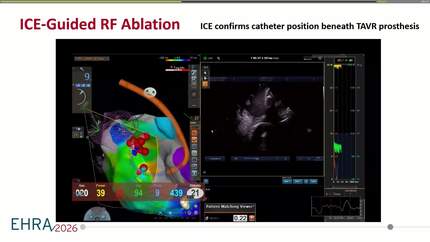
An 82-year-old Caucasian man presented with recurrent episodes of lipothymia and VT occurring late after undergoing TAVR. The VT persisted despite escalating medical therapy. He was referred for catheter ablation using a transseptal approach. Electroanatomical mapping of the left ventricle identified the earliest VT activation at the interventricular septum, adjacent to the lower portion of the prosthetic aortic valve. The arrhythmia was successfully treated with targeted radiofrequency ablation. At 11 months post-ablation, remote monitoring confirmed that the patient remained free of VT episodes.
This case report highlights a rare complication of TAVR. Clinicians should consider VT as a potential cause of presyncope or syncope following TAVR, rather than attributing these symptoms solely to conduction disorders. In this case, we demonstrate that catheter ablation targeting the interventricular septum near the lower portion of a 29-mm Edwards Sapien aortic valve was both feasible and effective.
Contributors

Baudouin Koenig
Author
Simon Fitouchi
Author
Loïc Faucher
Author
Laurence Jesel
Author
Halim Marzak
Author
Andreas Metzner
Author
Thomas Fink
Author
Nikolaos Spinthakis
Author
You may be interested in