Risk assessment for premature atherosclerosis in childhood cancer survivors: a case-control study from the PCS2 cohort
European Heart Journal Supplements


Abstract
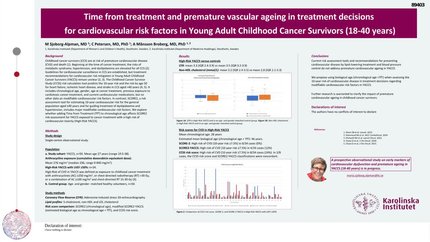
Childhood cancer survivors (CCS) face a 5-fold increased risk for cardiovascular disease which represents the leading non-cancer cause of premature death in this population[1]. Cardiomyopathy, coronary artery disease (CAD) and cardiovascular risk factors are tracked, but there is limited knowledge about vascular health[2;3]. Aortic stiffness is an indicator of vascular disease, and its increase might be a determinant of vascular events[3;4].
This study aimed to evaluate vascular markers of early atherosclerosis in a large cohort of CCS compared to matched-healthy controls using a comprehensive non-invasive vascular assessment.
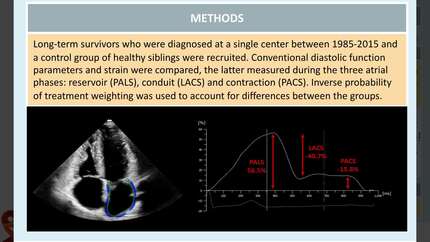
We conducted a case-control study of CCS treated with anthracyclines from the PCS2 (Preventing Cardiac Sequelae in Pediatric Cancer Survivors) study at the Hospital for Sick Children and Princess Margaret Cancer Centre, Toronto. Participants underwent a non-invasive protocol assessing vascular parameters, carotid intima-media thickness (cIMT), vascular stiffness with carotid-femoral pulse wave velocity (cfPWV), carotid stiffness index, carotid distensibility, flow mediated dilation (FMD), EndoPAT and cardiac assessment with echocardiography.
The study included 206 CCS and 150 healthy-matched controls (mean age 17.4±8.1 years 45.6% female and 19.1± 9.7 years 51.3% female, respectively). Early CCS (i.e. < 10 years since cancer-related treatment) represented 44.7% of the cohort. There was no significant difference of vascular markers of early atherosclerosis between CCS and controls including cfPWV (5.5±0.9 vs. 5.6±0.9m/s, p=0.94), cIMT (0.046±0.01 vs. 0.046±0.01cm, p=0.71), and FMD (6.36±3.1 vs. 6.25±3.2%, p=0.58). cfPWV was positively associated with male sex (β0=3.1; 95%CI 0.246; P<0.001) and with age at vascular assessment (β0=3.1; 95%CI 0.077; P<0.001). CIMT, cfPWV, carotid stiffness index and distensibility were significantly altered in late CCS compared to early CCS (respectively p=0.04, p<0.001, p<0.001 and p<0.001). CCS presented a statistical significative decrease in systolic and diastolic left ventricular function.
No significant difference in vascular markers of early atherosclerosis were found between CCS and controls. Late CCS presented significant altered vascular parameters compared to early CCS. Cardiac function differences were noted in CCS, though clinically insignificant. Further research is addressed to analyze the factors contributing to CAD risk in this population, with the goal of enabling earlier detection and intervention for improved overall outcomes.
Contributors


E Fournier
Author
R Joye
Author
M Signorile
Author
W Hui
Author
C Slorach
Author
M Friedberg
Author
E Lam
Author
K Runeckles
Author
S Fan
Author
B Mc Criendle
Author
L Mertens
Author
P Nathan
Author
You may be interested in