Greenness exposure and mortality risk in a cardio-oncologic population
European Heart Journal - Quality of Care and Clinical Outcomes


Abstract
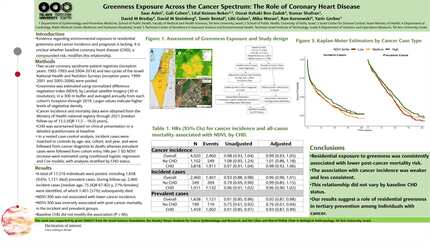
Knowledge is lacking on the relationship between greenness and mortality in cancer survivors who experience coronary artery disease, a cardio-oncologic population. We aimed to investigate the association between residential greenness exposure and all-cause mortality in a cardio-oncologic population.
Cancer survivors undergoing percutaneous coronary intervention at the Rabin Medical Center in Israel between 2004 and 2014 were included in the study. Clinical data were collected from medical records during index hospitalization and from the Israeli National Cancer Registry. Residential greenness was estimated by the normalized difference vegetation index (NDVI), a satellite-based index derived from Landsat imagery at a 30-m spatial resolution, with larger values indicating higher levels of vegetative density (ranging between −1 and 1). Mortality follow-up data were obtained through the end of 2021. Cox models were used to assess the hazard ratios (HRs) for all-cause mortality per 1SD increase in NDVI. Among 1331 patients analysed [mean (SD) age, 75.6 (10.2) years, 373 (28%) females], the mean (SD) NDVI within a 300-m radius was 0.12 (0.03). During a median follow-up period of 12.0 (IQR 9.2–14.7) years, 883 (66%) participants died. After adjustment for potential confounding factors, including residential socioeconomic status, air pollution, and smoking, NDVI was inversely associated with mortality hazard [HR (95% CI) = 0.93 (0.86, 0.99);
In a cohort of cardio-oncologic patients, greenness was independently associated with lower mortality.
Contributors

Saar Ashri
Author
Gali Cohen
Author
Osnat Itzhaki Ben Zadok
Author
Mika Moran
Author
David M Broday
Author
David M Steinberg
Author
Lital Keinan-Boker
Author
Guy Witberg
Author
Tamir Bental
Author
Lihi Golan
Author
Itamar Shafran
Author
Ran Kornowski
Author

You may be interested in