Impact of abnormal electrocardiogram findings on cardiovascular care: findings from 15 years of health check-ups
EP Europace Journal


Abstract
Health check-ups are routinely conducted in Japan for the early detection and initiation of treatment for diseases, in which a resting electrocardiogram (ECG) are often measured. However, evidence regarding the effectiveness of routine ECG screening in improving cardiovascular care in the general population remains limited.
This study aimed to evaluate the efficacy of ECG screening by assessing its positive predictive value, specifically, the proportion of individuals identified as needing cardiovascular care based on abnormal ECG findings during routine health check-ups.
This cohort study included individuals aged ≥18 years who underwent health check-ups at our institute between April 1, 2008, and March 31, 2023. This study population comprised those who underwent resting ECG. We evaluated the rate of recommendations for medical consultation prompted by abnormal ECG findings, identified using Minnesota codes and patient history obtained during health-checkups. The primary outcome was the decision of healthcare providers to initiate medical intervention or follow-up after those consultations.
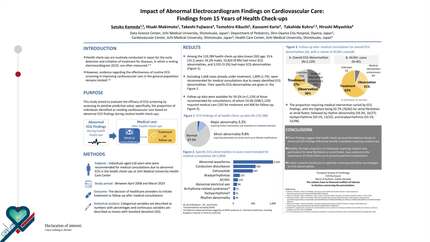
Among the 110,807 participants (mean [SD] age, 53.6 [10.1] years; 56.2% male), 10,824 (9.8%) had minor ECG abnormalities, and 3,535 (3.2%) had major ECG abnormalities (Figure 1). Excluding 1,668 individuals already under treatment, 1,899 (1.7%) individuals were recommended for medical consultations due to newly identified ECG abnormalities. Their specific ECG abnormalities included 1,426 with abnormal waveforms (75.1%), 520 with tachyarrhythmia (27.4%, excluding atrial fibrillation and atrial flutter), 271 with bradyarrhythmia (14.3%), 119 with atrial fibrillation or atrial flutter (6.3%), 116 with abnormal electrical axis (6.1%), and 36 with suspected arrhythmia-related syndromes, specifically Brugada syndrome or Wolff-Parkinson-White (WPW) syndrome (1.9%). Follow-up data were available for 59.5% (n=1,129) of those recommended for consultations, of whom 52.9% (597/1,129) required medical care (191 for treatment and 406 for follow-up; Figure 2). The proportion requiring medical care varied by ECG findings, with the highest being 92.7% (76/82) for atrial fibrillation or atrial flutter, followed by arrhythmia-related syndromes (66.7%, 10/15), bradyarrhythmia (58.0%, 97/167), and tachyarrhythmia (55.6%, 180/324).
These findings suggest that health check-up recommendations based on abnormal ECG findings effectively identify individuals requiring medical care. Notably, the high proportion of individuals requiring medical care, particularly for atrial fibrillation or atrial flutter, may underscore the importance of timely follow-up to prevent potential complications. Further research should aim to optimize screening and follow-up strategies for ECG abnormalities.
Contributors

S Kameda
Author
H Makimoto
Author
T Fujiwara
Author
T Kikuchi
Author
K Kario
Author
T Kohro
Author
H Miyashita
Author
You may be interested in