A virtual atrial fibrillation clinic after pulmonary vein isolation: lessons learned from 1000 patient-years
EP Europace Journal


Abstract
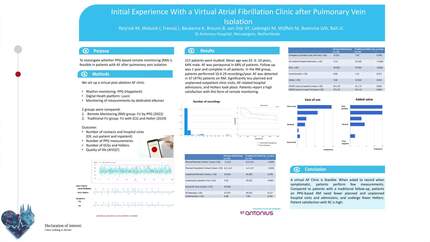
A virtual atrial fibrillation (AF) clinic was established to detect recurrent AF following pulmonary vein isolation (PVI). Previous research indicated that asymptomatic patients post-PVI conducted few or no measurements, affecting the quality of follow-up data. However, the optimal measurement frequency for effective follow-up remains unclear.
To determine the optimal measurement instructions for photopletysmography (PPG)-assessed AF follow-up after PVI.
Patients were provided with a PPG application embedded in a Digital Health platform, monitored by trained eNurses. Three groups were studied; 1: group S: measurements taken when symptomatic or at will, 2: group SW: measurements taken when symptomatic, at will, plus weekly, and 3: group SWP: measurements taken when symptomatic, at will, plus weekly, with push notification reminders for weekly measurements. The relationship between AF recurrence and symptoms was analysed.
This study included 1384 patients with a follow-up of one year, yielding 41068 measurements. The main monthly measurements per patient were 3.1 ± 4.4, 3.2 ± 1.8 and 5.1 ± 4.9 for groups S, SW, and SWP, respectively. The percentage of measurements detecting AF was 18% in group S, 14% in group SW, and 16% in group SWP. Notably, 33% of symptomatic measurements indicated AF, while 45% of AF-positive measurements were asymptomatic.
PPG monitoring post-PVI for one year revealed that push notifications for weekly measurements provided more comprehensive data on AF recurrence compared to control groups without such reminders. A weak correlation between AF recurrence and symptoms was observed. Number of measurement with and without s
Contributors

M Reijrink-De Boer
Author
K F Beukema
Author
V F Van Dijk
Author
M Liebregts
Author
M C E F Wijffels
Author
L V A Boersma
Author
J C Balt
Author
You may be interested in