Deep neural network for atrial fibrillation and atrial tachycardia/atrial flutter classification in insertable cardiac monitor
EP Europace Journal


Abstract
Algorithmic differentiation of atrial fibrillation (AF) from atrial tachycardia/atrial flutter (AT/AFL) in insertable cardiac monitors (ICM) remains a challenge.
This study aimed to use a deep neural network (DNN) to classify AF and AT/AFL with the goal of inappropriate labeling reduction in ICM detected arrhythmia episodes.
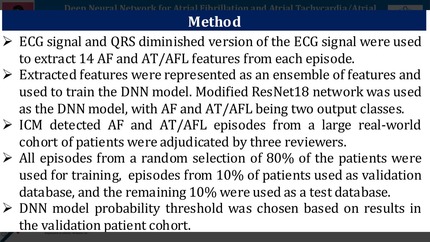
Raw EGM signal and the QRS diminished version of the raw signal were used to extract 14 AF and AT/AFL features from each episode. Extracted features were represented as an ensemble of features and used to train and test the DNN model. Modified ResNet18 network was used as the DNN model, with AF and AT/AFL being two output classes. ICM detected AF and AT/AFL episodes from a large real-world cohort of patients were adjudicated by three independent reviewers. All episodes from a random selection of 80% of the patients were used for training the DNN model, with episodes from an independent 10% of patients used as validation database, and episodes from the remaining 10% of patients were used as an independent test database to evaluate the DNN performance. The DNN model probability threshold was chosen based on results in the validation patient cohort. Episode classification accuracy and area under the curve (AUC) of receiver operating characteristics (ROC) curve in the independent test database are reported.
A total of 14,744 ICM detected AF and AT/AFL episodes in 1,513 patients (5,445 AF and 9,299 AT/AFL episodes) were included. Training dataset consisted of 11,827 episodes (1,211 patients), validation set consisted of 1,432 episodes (151 patients), and test set consisted of 1,485 episodes (151 patients). At the chosen threshold from validation set, 609 of 671 AF episodes and 671 of 814 AT/AFL episodes from test dataset were classified correctly by the DNN model, i.e., relative accuracy of 90.8% and 82.4% for AF and AT/AFL classification, respectively (Fig A). Overall, 86.2% of the episodes were classified correctly. The AUC of ROC for AF vs. AT/AFL on test data was 0.94 (Fig. B).
The DNN designed to discriminate between ICM detected AF and AT/AFL episodes can accurately categorize AF from AT/AFL in 90.8% of the cases and AT/AFL from AF in 82.4% of the cases. Adding more episodes to the current database should improve the performance. Confusion matrix and ROC curve compare
Contributors

You may be interested in