Enhancing thromboembolic and major adverse cardiac events risk assessment in atrial fibrillation using AI-driven ECG: a comparative analysis with CHA2DS2-VA scoring
EP Europace Journal


Abstract
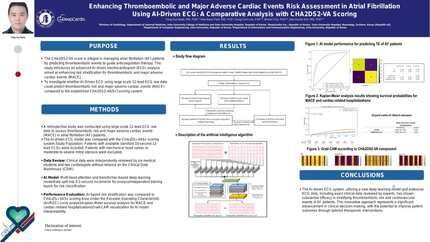
The CHA2DS2-VA score is integral in managing atrial fibrillation (AF) patients by predicting thromboembolic events to guide anticoagulation therapy. This study introduces an advanced AI-driven electrocardiogram (ECG) analysis aimed at enhancing risk stratification for thromboembolic and major adverse cardiac events (MACE).
To evaluate the effectiveness of an AI-driven ECG system in predicting thromboembolic risk and MACE in AF patients compared to the conventional CHA2DS2-VA scoring system.
Using data from 10,181 AF patients, we developed and validated an AI-driven ECG system employing transformer deep neural networks. This system processed 60,413 ECGs from our University Hospital, recorded between 2006 and 2021, alongside clinical records including CHA2DS2-VA scores and longitudinal follow-up data. Clinical analysis was meticulously validated by a team of seven experts, including cardiologists, to ensure robustness beyond traditional data warehouses.
The AI-driven ECG system effectively differentiated between low and high thromboembolic risks, demonstrating a significant difference in AI scores (35.22 ± 10.17 vs. 80.30 ± 8.77, p < 0.001) and achieving high predictive accuracy with an AUROC of 0.923 (95% CI 0.918 – 0.928). Performance metrics varied significantly across CHA2DS2-VA scores, with notable precision and recall differences between scores 0 and 2-8. Kaplan-Meier curves illustrated a marked survival difference between the risk groups in terms of MACE and related hospitalizations.
Our AI-driven ECG system, leveraging an innovative deep learning model and extensive, expert-reviewed clinical ECG data, has demonstrated superior efficacy in stratifying thromboembolic and cardiovascular risks in AF patients. This pioneering approach offers substantial improvements in clinical decision-making, potentially enhancing patient outcomes through more precise and individualized interventions.

You may be interested in