Inverse correlation between myocardial wall thickness and conduction velocity in the porcine atrium
EP Europace Journal


Abstract
Slow conducting regions may be a critical substrate for localized re-entry (1). Variations in myocardial wall thickness may impact atrial conduction velocity, particularly within structurally heterogeneous cardiac tissue (2). Although structural variations within the myocardium are known to impact electrical propagation, the direct correlation between wall thickness and conduction velocity in vivo is unknown.
This study investigates the correlation between myocardial wall thickness and conduction velocity in the porcine heart using computed tomography (CT) and electroanatomic mapping.
CT imaging and electroanatomic mapping during coronary sinus pacing were conducted in the porcine right atrium (n=8). CT images were post-processed to create wall thickness maps as previously described (3). Local activation time maps were post-processed to create conduction velocity maps using OpenEP (4-6). A geodesic path was defined on the posterior atrial wall from the level of the base of the appendage to the mid-point of the right atrium. Wall thickness measurements were obtained along these geodesic lines from CT data, while conduction velocities were calculated along the same paths using electroanatomic mapping data. The correlation between wall thickness and conduction velocity along these paths were quantified.
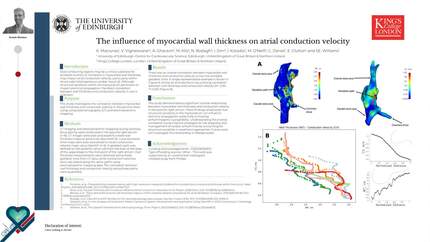
There was an inverse correlation between myocardial wall thickness and conduction velocity across the sampled geodesic lines. A single representative example is shown in Figure A. Across all animals there was a strong correlation between wall thickness and conduction velocity (R=-0.94, P<0.05) (Figure B).
This study demonstrated a significant inverse relationship between myocardial wall thickness and conduction velocity in the porcine right atrium. These findings emphasize how structural variations in the myocardium can influence electrical propagation, potentially increasing arrhythmogenic susceptibility. Understanding this inverse correlation could improve strategies for the diagnosis and management of cardiac arrhythmias by accounting for structural variability in treatment approaches. Future work will investigate this relationship in disease states.
Contributors

K Maciunas
Author
V Vigneswaran
Author
A Gharaviri
Author
M Klis
Author
N Bodagh
Author
I Sim
Author
I Kotadia
Author
M O'neill
Author
C Daniel
Author
E Clutton
Author
S E Williams
Author
You may be interested in