Discrimination of atrial fibrillation burden using clinical and cardiac imaging data
EP Europace Journal


Abstract
Current literature suggests that atrial fibrillation (AF) burden has prognostic implications in AF patients. However, it is not feasible to assess AF burden in all AF patients. Therefore, we aim to investigate whether clinical and cardiac imaging variables can stratify between a high and low AF burden.
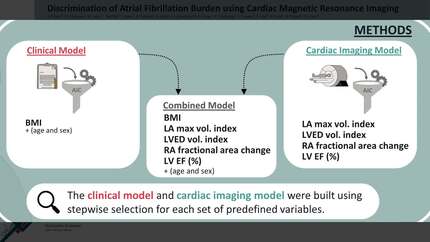
Data from 170 patients with paroxysmal (61%) or persistent (39%) AF at baseline, enrolled into the prospective, multicenter Swiss-AF Burden study, were analyzed. All patients underwent a 7-day Holter ECG and standardized cardiac magnetic resonance imaging (cMRI) without gadolinium. AF burden, defined as the percentage of time in AF, was dichotomized due to its nonlinear distribution and categorized as low (<10%) or high (≥10%). Both a clinical and cardiac imaging logistic regression model were built using a stepwise selection based on the Akaike Information Criterion (AIC) for each set of predefined variables (Figure). A combined model was then created by merging the clinical and imaging models. All models were adjusted to age and sex. Discriminative performance was evaluated by comparing AUCs.
The median age was 72 years, and 18% were female. Overall, 26% (n=44) had a high (≥10%) AF burden (Median 0%, IQR 15.3%). The selected variables in the clinical model were BMI, and in the cardiac imaging model LA max volume index, LVED volume index, RA fractional area change and LVEF. The AUCs (95% CI) for the clinical and cardiac imaging models were 0.67 (0.58–0.77) and 0.91 (0.84–0.98), respectively (Figure). Combining both models resulted in an AUC of 0.92 (0.86–0.99), with no substantial improvement over the cardiac imaging model alone. The estimated associations were [OR (95% CI)]: 1.16 (1.05–1.31) for BMI, 1.04 (1.01–1.07) for LA max volume index, 0.94 (0.91–0.97) for LVED volume index, 0.92 (0.87–0.97) for RA fractional area change and 0.88 (0.81–0.94) for LVEF.
Cardiac imaging variables possess superior discriminatory ability than clinical variables, suggesting their potential as a tool for estimating AF burden.
Contributors

A Gasser
Author
M Coslovsky
Author
M Liskij
Author
T Reichlin
Author
L Roten
Author
N Rodondi
Author
A Mueller
Author
G Moschovitis
Author
D Conen
Author
C Sticherling
Author
S Osswald
Author
P Haaf
Author
P Krisai
Author
M Kuehne
Author
C Zuern
Author
You may be interested in