Identification of triggers associated with health care-related adverse events in a cardiac care unit
European Heart Journal - Acute CardioVascular Care


Abstract
Type of funding sources: None.
health care-related adverse events (HCRAE) are a safety concern with serious consequences for hospitalized patients. In medical literature there is a lack of evidence about the incidence, characteristics and prevention of HCRAE in a cardiac care unit (CCU). This study evaluates the utility of predefined triggers from the Global Trigger Tool method that are associated with the appearance of HCRAE, for their early detection and prevention in critical cardiac patients.
validation of a set of predefined triggers from the Global Trigger Tool method that allow the detection of HCRAE in patients admitted to a CCU.
retrospective observational study. A review of medical history documents from a group of patients admitted to a CCU will be carried in search of HCRAE. The presence or absence of a set of predefined triggers from the Global Trigger Tool method will be analyzed in these patients. Statistical analysis will establish the relationship between the presence of these triggers and the incidence of HCRAE, as well as their sensitivity and specificity to detect these events.
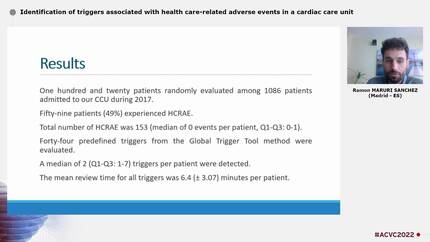
among 1086 patients admitted to a CCU during 2017, 120 were randomly evaluated. Fifty-nine patients (49%) experienced HCRAE. The total number of these events was 153 (at a median of 0 events per patient, Q1-Q3: 0-1). Forty-four predefined triggers from the Global Trigger Tool method were evaluated in all patients, regardless of whether or not they presented HCRAE. A median of 2 (Q1-Q3: 1-7) triggers per patient were detected. The mean review time for all triggers was 6.4 (± 3.07) minutes per patient. Among the 44 triggers evaluated, 7 were significantly associated with the incidence of HCRAE. These triggers are shown in Table 1. These triggers showed a sensitivity of 81% and a specificity of 90% for the detection of HCRAE. The ROC curve is shown in Figure 1.
HCRAE have serious consequences por patients; their prevention is a main goal for patient safety. In medical literature, there is a lack of evidence about this topic in the context of a CCU. In the present study, the incidence of HCRAE was evaluated in 120 critical cardiac patients. Forty-nine percent of patients experienced one or more HCRAE. Forty-four predefined triggers from the Global Trigger Tool method were evaluated; 7 of them were significantly associated with the incidence of HCRAE. These triggers showed a sensitivity of 81% and a specificity of 90% to detect HCRAE.
Table 1
Figure 1
Contributors



You may be interested in