Phosphoproteomics of phospholamban R14del heart tissue reveals aberrant regulation of calcium handling and contractility
EP Europace Journal


Abstract
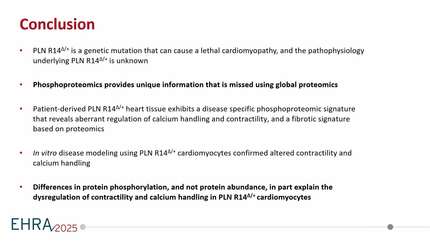
Phospholamban (PLN) p.Arg14del (R14del, R14Δ/+) is a pathogenic variant that can cause cardiomyopathy, characterized by abnormal sarcoplasmic reticulum (SR) clustering, ultimately leading to heart failure (HF). The exact pathophysiology is unknown. We aim to uncover R14Δ/+ disease mechanisms by studying the R14Δ/+ (phospho-)proteome.
Proteomics and phosphoproteomics was performed on explanted human heart tissue from end-stage R14Δ/+ patients (N=6) versus other etiologies of HF (N=10). To functionally study R14Δ/+ disease pathophysiology, CRISPR-Cas9 engineered R14Δ/+ and isogenic control (WT) induced pluripotent stem cell-derived cardiomyocytes (iPSC-CMs) were extensively characterized, including the proteome, phosphoproteome, calcium transients and contractility, and validated in R14Δ/+ iPSC-CMs derived from an R14Δ/+ patient.
(Phospho-)proteomics of heart tissue from R14Δ/+ vs. other etiologies of HF identified 246 differentially expressed proteins (DEPs) and 1507 differentially expressed phosphorylation sites (DEPSs). Gene ontology enrichment was performed on the identified DEPs and DEPSs, to identify related biological processes. Here, proteomics demonstrated that R14Δ/+ exhibited a fibrotic signature, distinguishing R14Δ/+ from other etiologies of HF. Phosphoproteomics demonstrated R14Δ/+ specific functional alterations related to contractility and calcium handling. (e.g. PKP2, ANK2, JPH2 hyper- and HRC, PLN, RYR2, SYNPO2L hypophosphorylation). In iPSC-CMs, (phospho-)proteomics of WT vs. R14Δ/+ identified 445 DEPs and 1757 DEPSs. Gene ontology enrichment revealed a R14Δ/+ specific metabolic signature using proteomics, whereas phosphoproteomics again revealed aberrant regulation of contractility and calcium handling in R14Δ/+ (e.g. SCN5A, SORBS1, LMOD2, EPB41L3 hyper- and RYR2, CTNNA3, SYNPO2L hypophosphorylation). In line with this, assessment of contractility in R14Δ/+ iPSC-CMs revealed faster contraction and relaxation, reported as decreased contraction velocity time, time to contract, contractile peak, relaxation velocity time and time to 80% relaxation. In relation to calcium in R14Δ/+ iPSC-CMs, faster calcium kinetics are observed, reported as have a decreased departure velocity time, time to calcium peak, return velocity time, time to 80% baseline and tau.
Phosphoproteomics provides unique information that is missed using regular proteomics. Patient-derived R14Δ/+ tissue exhibits a disease specific phosphoproteomic signature that reveals aberrant regulation of calcium handling and contractility. In vitro disease modeling using R14Δ/+ cardiomyocytes confirmed altered contractility and calcium handling.
Contributors

F E Deiman
Author
P Davidsson
Author
D Spater
Author
A N Linders
Author
K F Arevalo Gomez
Author
I B Dias
Author
A Esquivel-Gaytan
Author
J Zhu
Author
C Ahlstrom
Author
K M Hansson
Author
H H W Sillje
Author
N Bomer
Author
N Grote Beverborg
Author
P Van Der Meer
Author
You may be interested in