Telomere length is associated with adverse atrial remodeling in patients with atrial fibrillation
EP Europace Journal


Abstract
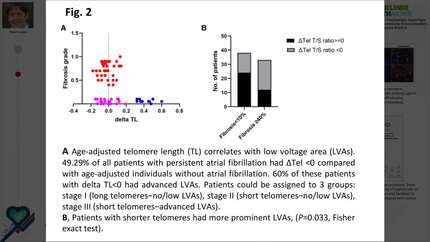
Atrial fibrillation (AF) is the most prevalent cardiac arrhythmia and poses a significant global health burden. Its prevalence increases markedly with age, affecting up to 18% of individuals over 80 years old. Telomeres, repetitive DNA sequences at the chromosomal ends, serve as biological markers of aging. This study aimed to explore the relationship between telomere shortening and AF, particularly in the context of atrial remodeling. Additionally, we investigated the gene expression profiles of AF patients based on telomere length (TL) and the extent of left atrial fibrosis.
A total of 72 patients undergoing catheter ablation for AF were included in this study. Bipolar voltage mapping was used to identify left atrial low-voltage areas (LVAs), which served as a surrogate marker for atrial fibrosis. Telomere length was measured and correlated with LVAs. Gene expression profiling was conducted using 3’ mRNA sequencing, and clonal hematopoiesis of indeterminate potential (CHIP) was evaluated via next-generation sequencing. Tert −/− and Terc −/− knockout mice models were employed to assess the mechanistic role of telomere shortening in atrial remodeling.
Patients with advanced left atrial fibrosis exhibited significantly shorter telomeres compared to those with minimal or no fibrosis. A strong correlation was observed between the extent of LVAs, TL, and clinical outcomes following AF ablation. After 24 months, only 26.5% of patients with severe fibrosis and short TL maintained sinus rhythm (SR), compared to 62.5% of patients with minimal fibrosis and longer telomeres. Gene expression profiles and CHIP occurrence differed between AF patients with short versus long telomeres. Furthermore, mouse models with telomere shortening displayed pronounced left atrial fibrosis and upregulation of fibrosis-related genes.
Telomere shortening is strongly associated with left atrial remodeling and fibrosis. Shortened telomeres are linked to molecular mechanisms that may contribute to the development of atrial fibrosis, thereby promoting the persistence of AF.
Contributors

You may be interested in