Excellent interobserver agreement and steep learning curve for target volume delineation for stereotactic arrhythmia radioablation using generally accessible software packages
EP Europace Journal


Abstract
Stereotactic arrhythmia radioablation (STAR) has emerged as bailout treatment for patients with refractory ventricular tachycardia (VT). However, the number of patients who require STAR remains low, emphasizing the need for accurate, reproducible and easy to learn workflows to transfer electroanatomical mapping (EAM) data to the planning CT.
To evaluate the interobserver variability and ease of use for STAR target volume delineation using the open-source 3D Slicer (
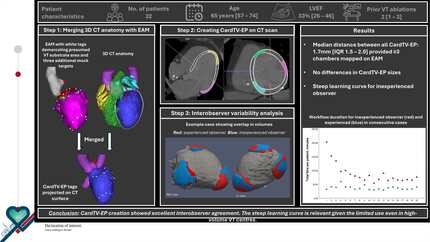
Twenty patients (non-ischemic etiology 16/20, LVEF median 32% [IQR 25 – 44] underwent EAM in preparation for STAR. Endocardial tags were placed on EAM to indicate the VT substrate location. Three additional remote endocardial areas were selected to simulate other STAR locations and their potential effect on the interobserver agreement. Based on endocardial areas transmural target volumes were created and transferred to the CT by an experienced observer and a medical student without prior experience in EAM and CT. Target volume sizes, Hausdorff distances (HD) and working time were calculated to determine interobserver variability and learning curve.
For the experienced operator, the Slicer workflow had longer working times (Slicer median 65 minutes [IQR 61 – 70] vs. ADAS 26 minutes [24 – 29] p<0.001)) with at least one software crash in 100% of cases performed in Slicer (zero crashes in ADAS), but resulted in comparable target volumes (median Hausdorff distance between volumes 3.64mm [2.7 – 4.5]).
After ten cases in ADAS the median workflow time of the inexperienced observer was 67 min [IQR 64 – 71], which was longer than the experienced observer (median 33 min [IQR 32 – 38], but shorter than a the experienced operator using the Slicer software (median duration 75 min [IQR 65 – 85]).
Linear regression analysis showed a steep learning curve using ADAS (distance between volumes R2 0.36, p<0.05). For the last fifteen cases there was no difference in target volume sizes between the experienced observer and the student (11.8 ml [IQR 10.1 – 13.7] vs. 10.7 ml [IQR 9.6 – 11.8] (P=0.17) and the distance between all created volumes was low (HD: 1.68mm [IQR 1.45 – 1.96]; 95th percentile HD below 4.8mm [IQR 3.5 – 5.7].
Usage of the ADAS software was robust with a steep learning curve and excellent interobserver agreement for unexperienced operators. While the Slicer 3D workflow is more time-consuming and experiences more software crashes, it is open-source and free-to-use. Creation and comparison target volumes Worflow duration for both observers
Contributors

You may be interested in