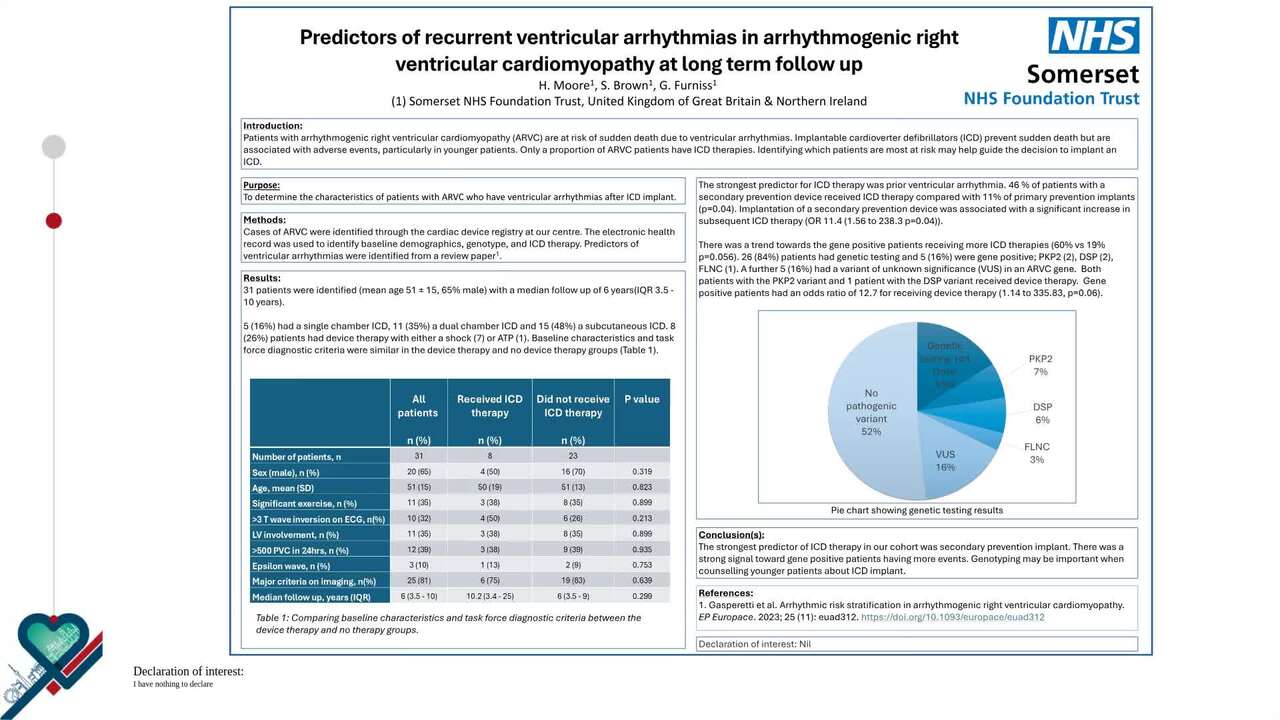
Predictors of recurrent ventricular arrhythmias in arrhythmogenic right ventricular cardiomyopathy at long term follow up
EP Europace Journal


Abstract
Patients with arrhythmogenic right ventricular cardiomyopathy (ARVC) are at risk of sudden death due to ventricular arrhythmias. Implantable cardioverter defibrillators (ICD) prevent sudden death but are associated with adverse events, particularly in younger patients. Only a proportion of ARVC patients have ICD therapies. Identifying which patients are most at risk may help guide the decision to implant an ICD.
To determine the characteristics of patients with ARVC who have ventricular arrhythmias after ICD implant.
Cases of ARVC were identified through the cardiac device registry at our centre. The electronic health record was used to identify baseline demographics, genotype, and ICD therapy. Predictors of ventricular arrhythmias were identified from a review paper1.
31 patients were identified (mean age 51 ± 15, 65% male) with a median follow up of 6 years(IQR 3.5 - 10 years).
5 (16%) had a single chamber ICD, 11 (35%) a dual chamber ICD and 15 (48%) a subcutaneous ICD. 8 (26%) patients had device therapy with either a shock (7) or ATP (1). Baseline characteristics and task force diagnostic criteria were similar in the device therapy and no device therapy groups (Table 1).
The strongest predictor for ICD therapy was prior ventricular arrhythmia. 46 % of patients with a secondary prevention device received ICD therapy compared with 11% of primary prevention implants (p=0.04). Implantation of a secondary prevention device was associated with a significant increase in subsequent ICD therapy (OR 11.4 (1.56 to 238.3 p=0.04))
There was a trend towards the gene positive patients receiving more ICD therapies (60% vs 19% p=0.056). 26 (84%) patients had genetic testing and 5 (19%) were gene positive; PKP2 (2), DSP (2), FLNC (1). A further 5 (19%) had a variant of unknown significance (VUS) in an ARVC gene. Both patients with the PKP2 variant and 1/2 patient with the DSP variant received device therapy. Gene positive patients had an odds ratio of 12.7 for receiving device therapy (1.14 to 335.83, p=0.06).
The strongest predictor of ICD therapy in our cohort was secondary prevention implant. There was a strong signal toward gene positive patients having more events. Genotyping may be important when counselling younger patients about ICD implant. Comparing characteristics

You may be interested in